

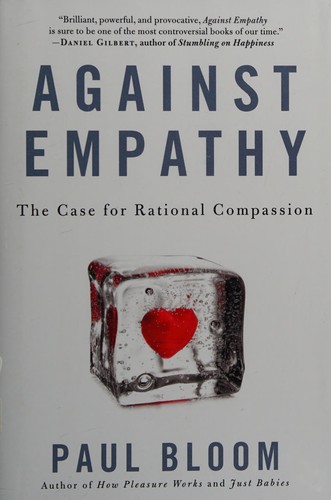
Against Empathy: The Case for Rational Compassion
Paul BloomAgainst Empathy: The Case for Rational Compassion
or to grade, review, and add to your backlog.
Description
"We often think of our capacity to experience the suffering of others as the ultimate source of goodness. Many of our wisest policy-makers, activists, scientists, and philosophers agree that the only problem with empathy is that we don't have enough of it. Nothing could be farther from the truth, argues Yale researcher Paul Bloom. In Against Empathy, Bloom reveals empathy to be one of the leading motivators of inequality and immorality in society. Far from helping us to improve the lives of others, empathy is a capricious and irrational emotion that appeals to our narrow prejudices. It muddles our judgment and, ironically, often leads to cruelty. We are at our best when we are smart enough not to rely on it, but to draw instead upon a more distanced compassion. Basing his argument on groundbreaking scientific findings, Bloom makes the case that some of the worst decisions made by individuals and nations--whom to give money to, when to go to war, how to respond to climate change, and whom to imprison--are too often motivated by honest, yet misplaced, emotions. With precision and wit, he demonstrates how empathy distorts our judgment in every aspect of our lives, from philanthropy and charity to the justice system and from medical care and education to parenting and marriage. Without empathy, Bloom insists, our decisions would be clearer, fairer, and--yes--ultimately more moral."--Dust jacket flap.
Community reviews
No reviews yet. Be the first to review this book.
More like this

Notes on a Nervous Planet
Matt Haig

Just My Luck! Embarrassing Moments And The Girls Who Survive Them
Robin Wasserman
The Chomsky-Foucault Debate: On Human Nature
Noam Chomsky

The System of Objects
Jean Baudrillard

Le systeme des objets
Jean Baudrillard

Life and How To Survive It
John Cleese

Quantum Psychology
Robert Anton Wilson

Cosmic Trigger 3: My Life After Death
Robert Anton Wilson