

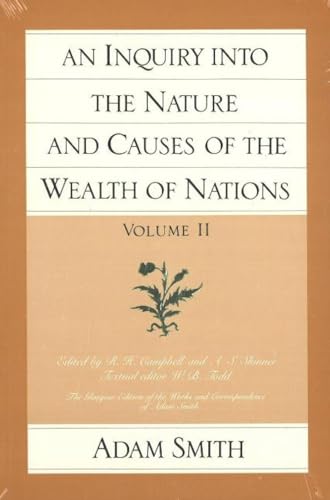
An Inquiry into the Nature and Causes of the Wealth of Nations, Volume II
or to grade, review, and add to your backlog.
Description
First published in 1776, the year in which the American Revolution officially began, Smith's Wealth of Nations sparked a revolution of its own. In it Smith analyzes the major elements of political economy, from market pricing and the division of labor to monetary, tax, trade, and other government policies that affect economic behavior. Throughout he offers seminal arguments for free trade, free markets, and limited government. Criticizing mercantilists who sought to use the state to increase their nations' supply of precious metals, Smith points out that a nation's wealth should be measured by the well-being of its people. Prosperity in turn requires voluntary exchange of goods in a peaceful, well-ordered market. How to establish and maintain such markets? For Smith the answer lay in man's social instincts, which government may encourage by upholding social standards of decency, honesty, and virtue, but which government undermines when it unduly interferes with the intrinsically private functions of production and exchange. Social and economic order arise from the natural desires to better one's (and one's family's) lot and to gain the praise and avoid the censure of one's neighbors and business associates. Individuals behave decently and honestly because it gives them a clear conscience as well as the good reputation necessary for public approbation and sustained, profitable business relations.
Community reviews
No reviews yet
Be the first to review this book.
More like this
- Milletlerin ZenginligiBook

- 16 tesis de economia politica. Interpretacion filosofica.Book

- A History of Economics: The Past as the PresentBook

- Throwing Rocks at the Google Bus: How Growth Became the Enemy of ProsperityBook

- The Poverty of PhilosophyBook

- More and More and MoreBook

- Les juifs, le monde et l'argentBook

- An Inquiry into the Nature and Causes of the Wealth of NationsBook