

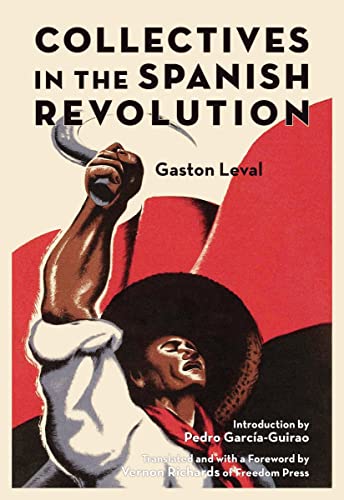
Collectives in the Spanish Revolution
Gaston LevalCollectives in the Spanish Revolution
or to grade, review, and add to your backlog.
Description
Gaston Leval's study brings together two aspects that are generally difficult to unite--analysis and testimony. He visited the towns and villages of revolutionary Spain where people had opted to live a libertarian communist lifestyle almost without precedent in history, collectivizing the land, factories, and social services. Collectives in the Spanish Revolution demonstrates clearly that the working class are perfectly capable of running farms, factories, workshops, and health and public services without bosses or managers. It proves that anarchist methods of organizing, with decisions made from the bottom up, can work effectively in large-scale industry, involving the coordination of many thousands of workers in many hundreds of places of work across numerous cities and towns, as well as broad rural areas. Leval's history of anarchy in action also gives insight into the creative and constructive power of ordinary people. The Spanish working class not only kept production going throughout the war, but in many cases managed to achieve increases in output. They improved working conditions and created new techniques. They created, out of nothing, an arms industry without which the war against fascism could not have been fought. The revolution also showed that without the competition bred by capitalism, industry can be run in a much more rational manner. Finally it demonstrated how an organized working class has the power to transform society.
Community reviews
No reviews yet. Be the first to review this book.
More like this
El dinero: De donde vino y adonde fue
John Kenneth Galbraith

Exit, Voice, and Loyalty: Responses to Decline in Firms, Organizations, and States
Albert O. Hirschman
National Power and the Structure of Foreign Trade
Albert O. Hirschman
Profit and Crises
Arghiri Emmanuel
The Ethics Of Competition
Frank H. Knight

Economics: Principles and Policy, Update 2010 Edition
William J. Baumol
World Hunger: Twelve Myths
Frances Moore Lappe
Teoria dei giochi
Oskar Morgenstern