

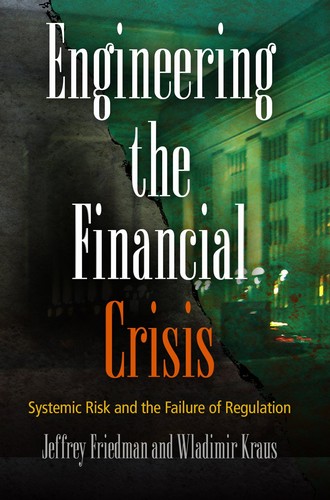
Engineering the Financial Crisis: Systemic Risk and the Failure of Regulation
Jeffrey Friedman, Wladimir KrausEngineering the Financial Crisis: Systemic Risk and the Failure of Regulation
or to grade, review, and add to your backlog.
Description
One of the lasting legacies of Reaganomics is a deep-seated distrust of government intervention in the markets. Despite this still-popular sentiment, the Basel Accords, a set of international standards for banking supervision and regulation, have been the subject of remarkably little public criticism. While academics and practitioners decry the enforcement of the Sarbanes-Oxley Act on accounting reform or attempts by Congress to regulate executive compensation, the Basel Accords have been quietly accepted. In one of the first studies critically to examine the Basel Accords, Engineering the Financial Crisis reveals the crucial role that bank capital requirements and other government regulations played in the recent financial crisis. Jeffrey Friedman and Wladimir Kraus argue that by encouraging banks to invest in highly rated mortgage-backed bonds, the Basel Accords created an overconcentration of risk in the banking industry. In addition, accounting regulations required banks to reduce lending if the temporary market value of these bonds declined, as they did in 2007 and 2008 during the panic over subprime mortgage defaults. The book begins by assessing leading theories about the crisis—deregulation, bank compensation practices, excessive leverage, "too big to fail," and Fannie Mae and Freddie Mac—and, through careful evidentiary scrutiny, debunks much of the conventional wisdom about what went wrong. It then discusses the Basel Accords and how they contributed to systemic risk. Finally, it presents an analysis of social-science expertise and the fallibility of economists and regulators. Engagingly written, theoretically inventive, yet empirically grounded, Engineering the Financial Crisis is a timely examination of the unintended—and sometimes disastrous—effects of regulation on complex economies.
Community reviews
No reviews yet. Be the first to review this book.
More like this
Capitalism: A Global History
Sven Beckert

Kogda grabit' bank i drugie lajfhaki
Steven D. Levitt

Why Should Anyone Be Led by You?: What It Takes To Be An Authentic Leader
Rob Goffee

Why Should Anyone Work Here?: What It Takes to Create an Authentic Organization
Rob Goffee

How to Prosper in Hard Times: Blueprints for Abundance by the Greatest Motivational Teachers of All Time
James Allen

The Indispensable Milton Friedman: Essays on Politics and Economics
Milton Friedman

Your First 1000 Copies: The Step-by-Step Guide to Marketing Your Book
Leslie Watts

The Inner Lives of Markets: How People Shape Them-And They Shape Us
Ray Fisman