

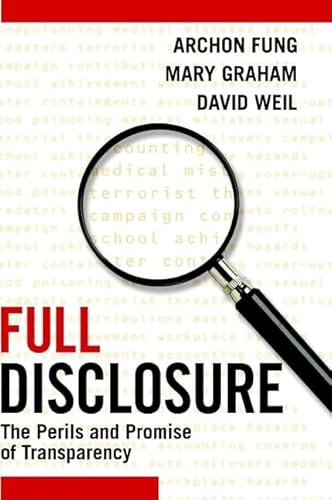
Full Disclosure: The Perils and Promise of Transparency
Archon Fung, Mary Graham, David WeilFull Disclosure: The Perils and Promise of Transparency
or to grade, review, and add to your backlog.
Description
Which SUVs are most likely to rollover? What cities have the unhealthiest drinking water? Which factories are the most dangerous polluters? What cereals are the most nutritious? In recent decades, governments have sought to provide answers to such critical questions through public disclosure to force manufacturers, water authorities, and others to improve their products and practices. Corporate financial disclosure, nutritional labels, and school report cards are examples of such targeted transparency policies. At best, they create a light-handed approach to governance that improves markets, enriches public discourse, and empowers citizens. But such policies are frequently ineffective or counterproductive. Based on an analysis of eighteen U.S. and international policies, Full Disclosure shows that information is often incomplete, incomprehensible, or irrelevant to consumers, investors, workers, and community residents. To be successful, transparency policies must be accurate, keep ahead of disclosers' efforts to find loopholes, and, above all, focus on the needs of ordinary citizens.
Community reviews
No reviews yet
Be the first to review this book.
More like this
 The Politically Incorrect Guide to Socialism
 The Case for Socialism
 Payback: Debt and the Shadow Side of Wealth
 Nei nostri sogni esiste un altro mondo. Appunti dal movimento zapatista
 The Official Fahrenheit 9/11 Reader
 Truth, Torture, and the American Way: The History and Consequences of U.S. Involvement in Torture
 Our Endangered Values: America's Moral Crisis
 Next: Piccolo libro sulla globalizzazione e sul mondo che verra