

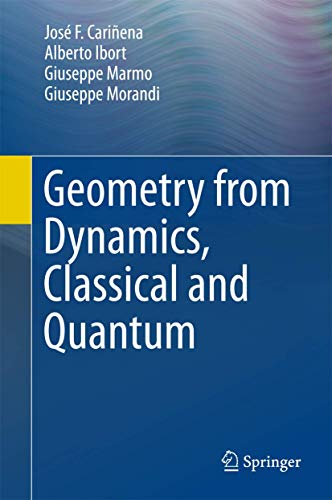
Geometry from Dynamics, Classical and Quantum
Jose F. Carinena, Alberto Ibort, Giuseppe Marmo, Giuseppe MorandiGeometry from Dynamics, Classical and Quantum
or to grade, review, and add to your backlog.
Description
This book describes, by using elementary techniques, how some geometrical structures widely used today in many areas of physics, like symplectic, Poisson, Lagrangian, Hermitian, etc., emerge from dynamics. It is assumed that what can be accessed in actual experiences when studying a given system is just its dynamical behavior that is described by using a family of variables ("observables" of the system). The book departs from the principle that ''dynamics is first'', and then tries to answer in what sense the sole dynamics determines the geometrical structures that have proved so useful to describe the dynamics in so many important instances. In this vein it is shown that most of the geometrical structures that are used in the standard presentations of classical dynamics (Jacobi, Poisson, symplectic, Hamiltonian, Lagrangian) are determined, though in general not uniquely, by the dynamics alone. The same program is accomplished for the geometrical structures relevant to describe quantum dynamics. Finally, it is shown that further properties that allow the explicit description of the dynamics of certain dynamical systems, like integrability and superintegrability, are deeply related to the previous development and will be covered in the last part of the book. The mathematical framework used to present the previous program is kept to an elementary level throughout the text, indicating where more advanced notions will be needed to proceed further. A family of relevant examples is discussed at length and the necessary ideas from geometry are elaborated along the text. However no effort is made to present an ''all-inclusive'' introduction to differential geometry as many other books already exist on the market doing exactly that. However, the development of the previous program, considered as the posing and solution of a generalized inverse problem for geometry, leads to new ways of thinking and relating some of the most conspicuous geometrical structures appearing in Mathematical and Theoretical Physics.
Community reviews
No reviews yet. Be the first to review this book.
More like this

Bogus Science: Or, Some People Really Believe These Things
John Grant

Denying Science: Conspiracy Theories, Media Distortions, and the War Against Reality
John Grant

On the Future: Prospects for Humanity
Martin J. Rees

How to Destroy the Universe: and 34 Other Really Interesting Uses of Physics
Paul Parsons
Steps Toward Large-Scale Data Integration in the Sciences: Summary of a Workshop
National Research Council

Learning Science in Informal Environments: People, Places, and Pursuits
National Research Council

Water Reuse: Potential for Expanding the Nation's Water Supply Through Reuse of Municipal Wastewater
National Research Council

This Idea Is Brilliant: Lost, Overlooked, and Underappreciated Scientific Concepts Everyone Should Know
John Brockman