

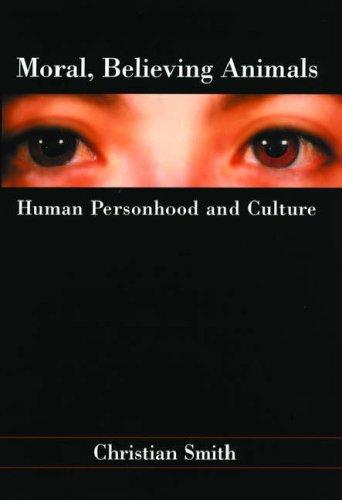
Moral, Believing Animals: Human Personhood and Culture
Christian SmithMoral, Believing Animals: Human Personhood and Culture
or to grade, review, and add to your backlog.
Description
"Smith suggests that human beings have a peculiar set of capacities and proclivities that distinguishes them significantly from other animals on this planet. Despite the vast differences in humanity between cultures and across history, no matter how differently people narrate their lives and histories, there remains an underlying structure of human personhood that helps to order human culture, history, and narration. Drawing on important recent insights in moral philosophy, epistemology, and narrative studies, Smith argues that humans are animals with an inescapable moral and spiritual dimension. They cannot avoid a fundamental moral orientation in life, and this, says Smith, has profound consequences for how sociology must study human beings. Similarly, humans cannot escape living by one or another sacred narrative, and this too has important implications for sociology. Along the way, Smith advances a sustained critique of rational choice theory, sociobiology, and other accounts of human social life drawn from the naturalistic, antimentalist, noncultural tradition of Western social theory as badly misunderstanding the character of the human animal. By contrast, this work argues that all people are at bottom believers whose lives, actions, and institutions are constituted, motivated, and governed by narrative traditions and moral orders on which they inescapably depend." "This approach - which has profound consequences for how we think about knowledge, culture, social action, institutions, religion, and the task of the social sciences - will be of interest to scholars in sociology, social theory, religious and cultural studies, psychology, and anthropology."--Jacket.
Community reviews
No reviews yet
Be the first to review this book.
More like this
 The Essential Foucault: Selections from the Essential Works of Foucault, 1954-1984
 Baseball and Philosophy: Thinking Outside the Batter's Box
 Consciousness: A Very Short Introduction
 Kierkegaard's Concept of Existence
 Cumulative Index to Kierkegaard's Writings
 Screened Out
 Fragments
 Can Socialists be Happy?