

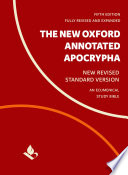
The New Oxford Annotated Apocrypha: New Revised Standard Version
Marc BrettlerThe New Oxford Annotated Apocrypha: New Revised Standard Version
or to grade, review, and add to your backlog.
Description
For decades students, professors, clergy, and general readers have relied on The New Oxford Annotated Apocrypha as an unparalleled authority on the Apocrypha. This fifth edition remains the best way to study and understand the material at home or in the classroom. This thoroughly revised and substantially updated edition contains the best scholarship informed by recent discoveries and anchored in the solid Study Bible tradition. · Introductions and extensive annotations for each book by acknowledged experts in the field provide context and guidance. · Introductory essay on the Apocrypha gives readers an overview that guides more intensive study. · Maps and diagrams within the text contextualize where events took place and how to understand them. · A timeline, calendar, and essay on the Persian and Hellenistic Periods help to contextualize the books. A volume that users will want to keep for continued reference, The New Oxford Annotated Apocrypha continues the Oxford University Press tradition of providing excellence in scholarship for the general reader. Generations of users attest to its status as the best one-volume Bible reference tool for any home, library, or classroom.
Community reviews
No reviews yet
Be the first to review this book.
More like this
 YOUCAT Bible: An Introduction to the Bible with Selected Biblical Texts
 NIV Study Bible, Fully Revised Edition
 NIV, Quest Study Bible, Hardcover, Blue, Comfort Print: The Only Q and A Study Bible
 NIV, Proclamation Bible: Correctly Handling the Word of Truth
 ESV Expository Commentary: Romans-Galatians
 ESV Expository Commentary: Matthew-Luke
 Why Are There Differences in the Gospels?: What We Can Learn from Ancient Biography
 NIV Lectio Bible: A simple, ancient way to read the library of Scripture, Cloth over Board: The Practicing the Way edition with an introduction by John Mark Comer