

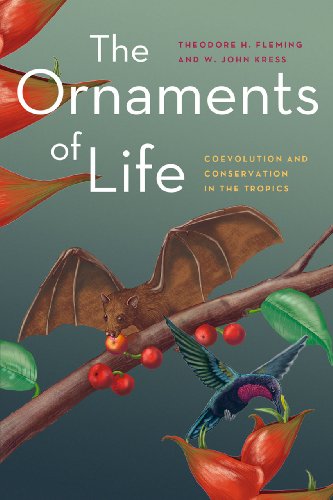
The Ornaments of Life: Coevolution and Conservation in the Tropics
Theodore H. FlemingThe Ornaments of Life: Coevolution and Conservation in the Tropics
or to grade, review, and add to your backlog.
Description
The average kilometer of tropical rainforest is teeming with life; it contains thousands of species of plants and animals. As The Ornaments of Life reveals, many of the most colorful and eye-catching rainforest inhabitants—toucans, monkeys, leaf-nosed bats, and hummingbirds to name a few—are an important component of the infrastructure that supports life in the forest. These fruit-and-nectar eating birds and mammals pollinate the flowers and disperse the seeds of hundreds of tropical plants, and unlike temperate communities, much of this greenery relies exclusively on animals for reproduction. Synthesizing recent research by ecologists and evolutionary biologists, Theodore H. Fleming and W. John Kress demonstrate the tremendous functional and evolutionary importance of these tropical pollinators and frugivores. They shed light on how these mutually symbiotic relationships evolved and lay out the current conservation status of these essential species. In order to illustrate the striking beauty of these “ornaments” of the rainforest, the authors have included a series of breathtaking color plates and full-color graphs and diagrams.
Community reviews
No reviews yet. Be the first to review this book.
More like this

Two Billion Cars: Driving Toward Sustainability
Arnold Schwarzenegger

Bogus Science: Or, Some People Really Believe These Things
John Grant

Denying Science: Conspiracy Theories, Media Distortions, and the War Against Reality
John Grant

On the Future: Prospects for Humanity
Martin J. Rees

How to Destroy the Universe: and 34 Other Really Interesting Uses of Physics
Paul Parsons

Das Universum fur Eilige
Neil deGrasse Tyson

Steps Toward Large-Scale Data Integration in the Sciences: Summary of a Workshop
National Research Council

Learning Science in Informal Environments: People, Places, and Pursuits
National Research Council