

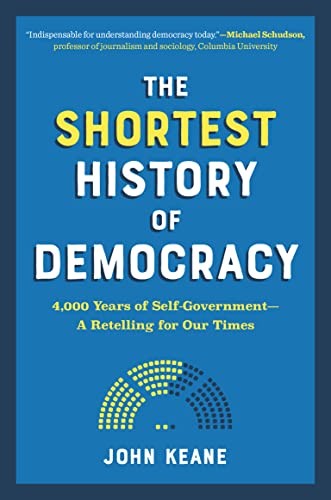
The Shortest History of Democracy: 4,000 Years of Self-Government-A Retelling for Our Times
John KeaneThe Shortest History of Democracy: 4,000 Years of Self-Government-A Retelling for Our Times
The Shortest History of Democracy: 4,000 Years of Self-Government―A Retelling for Our Times
or to grade, review, and add to your backlog.
Description
In an age of intense social and political polarization, the radical potential of democracy is more important than ever, as revealed in this illuminating history by a celebrated political theorist. From its beginnings in Syria-Mesopotamia and Athens to its role in fomenting revolutionary fervor in France and America, democracy has subverted fixed ways of deciding who should enjoy power and privilege—and why. Democracy encourages people to do something radical: to come together as equals, to determine their own lives and futures. In The Shortest History of Democracy, acclaimed political thinker John Keane traces its byzantine history, from the age of assembly democracy in the Middle East and Greece to European-inspired electoral democracy and the birth of representative government to our age of “monitory democracy”—a helpful concept the author introduces to describe how democratic governments today are under constant media-driven public scrutiny (monitoring) and held accountable by watchdog organizations of every stripe. Keane calls this “the most complex and vibrant form of democracy yet,” reaching far beyond just casting one’s vote on election day. Democracy today is defined by the rapid growth of many new kinds of extra-governmental watchdog mechanisms that reach into every aspect of public and private life—think investigative journalism, activism, strikes, election monitoring, climate action networks, public outcries against scandal and corruption. As the world has come to be shaped by democracy, it has grown more worldly; American-style liberal democracy is giving way to regional varieties in places such as Taiwan, India, Senegal, and South Africa. Meanwhile, despotic regimes in Turkey, Russia, Hungary, the United Arab Emirates, Iran, and China reject the promises of power-sharing democracy. Keane gives new reasons why democracy is a precious global ideal, and how the voice and vote of the average citizen has multiplied through the proliferation of different power-checking outlets. In an age of crisis, he argues, we need the “radical potential of democracy” more than ever. Does democracy have a future, or will the demagogues and despots win? We are about to find out.
Community reviews
No reviews yet. Be the first to review this book.
More like this
The Architecture of Modern Empire
Arundhati Roy

The Confounding Island: Jamaica and the Postcolonial Predicament
Orlando Patterson

In Defense of the Second Amendment
Larry Correia

Climate Crisis and the Global Green New Deal: The Political Economy of Saving the Planet
Robert Pollin

Trump on Trial: The Investigation, Impeachment, Acquittal and Aftermath
The Washington Post

How Politics Works
D.K. Publishing

Dear Zealots: Letters from a Divided Land
Amos Oz

Trump vs. China: Facing America's Greatest Threat
Newt Gingrich