

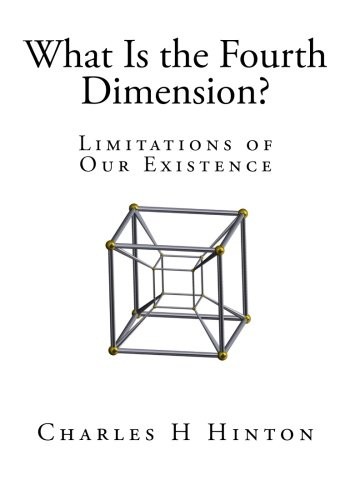
What Is the Fourth Dimension?: Limitations of Our Existence
Charles Howard HintonWhat Is the Fourth Dimension?: Limitations of Our Existence
or to grade, review, and add to your backlog.
Description
What Is the Fourth Dimension? Limitations of Our Existence By Charles H. Hinton Charles Howard Hinton (1853, UK – 30 April 1907, Washington D.C., USA) was a British mathematician and writer of science fiction works titled Scientific Romances. He was interested in higher dimensions, particularly the fourth dimension. He is known for coining the word "tesseract" and for his work on methods of visualising the geometry of higher dimensions. AT the present time our actions are largely influenced by our theories. We have abandoned the simple and instinctive mode of life of the earlier civilizations for one regulated by the assumptions of our knowledge and supplemented by all the devices of intelligence. In such a state it is possible to conceive that a danger may arise, not only from a want of knowledge and practical skill, but even from the very presence and possession of them in any one department, if there is a lack of information in other departments. If, for instance, with our present knowledge of physical laws and mechanical skill, we were to build houses without regard to the conditions laid down by physiology, we should probably--to suit an apparent convenience--make them perfectly draught-tight, and the best-constructed mansions would be full of suffocating chambers. The knowledge of the construction of the body and the conditions of its health prevent it from suffering injury by the development of our powers over nature. In no dissimilar way the mental balance is saved from the dangers attending an attention concentrated on the laws of mechanical science by a just consideration of the constitution of the knowing faculty, and the conditions of knowledge. Whatever pursuit we are engaged in, we are acting consciously or unconsciously upon some theory, some view of things. And when the limits of daily routine are continually narrowed by the ever-increasing complication of our civilization, it becomes doubly important that not one only but every kind of thought should be shared in.
Community reviews
No reviews yet
Be the first to review this book.
More like this
 What Is Subjectivity?
 Can Socialists be Happy?
 14 tesis de etica: Hacia la esencia del pensamiento critico
 Figures of Catastrophe: The Condition of Culture Novel
 How to Die
 Philosophy's Future: The Problem of Philosophical Progress
 Siete ensayos de filosofia de la liberacion: Hacia una fundamentacion del giro decolonial
 Baseball and Philosophy: Thinking Outside the Batter's Box