

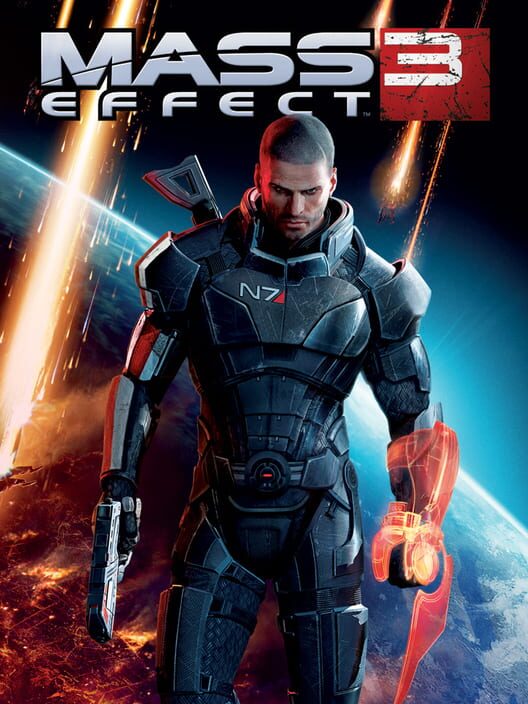
Review of Mass Effect 3 by Adam Milton
 Adam MiltonNovember 5, 20262 viewsAdam Milton on games. Graded 9 other games by BioWare, averaging B+ · 94 full reviews published
and grade a few things to see how Adam Milton’s taste matches yours.
I was on deployment in the middle of the ocean when Mass Effect 3 was released. I saw the backlash and memes all over social media before I even stepped foot on American soil. I had barely gotten back into the swing of things when I sat down to finally play it and see for myself.
Maybe I had been braced for the worst, but when I first finished Mass Effect 3 I did not hate it. I was expecting a broken game, the way people were talking about it. The ending, most people’s point of contention, was more confusing than anything. I had more questions. I felt like I missed something. I must have.
What was hardest, though, was that before the last thirty minutes or so this was an excellent game. Yes, I said excellent. The story, gunplay, new enemies, fan‑service cameos, music, and new mechanics all hit just right. But that ending. It is hard not to let that sour your entire experience.
The big threat of the past two games, the one you have been holding back, preparing for, and terrified of, has arrived. The Reapers have started their invasion. Earth is attacked and you are thrown into the heat of combat right before you leave to rally the galaxy. Though from context clues in previous games you know that the previous invasions took hundreds of years, the pressure is on to gather the resources and allies in order to make one final stand against an enemy that is closer to a force of nature than an enemy army.
The combat in Mass Effect 3 is the most fluid in the trilogy. More than just having the benefit of years of refinement and improvement, the combat in ME3 makes your Shepard feel appropriately dangerous. There is real weight to your character’s movement, power in every melee strike, pop in every weapon. You move fluidly in and out of cover and hurdle obstacles, the camera keeping up, bouncing, and shuddering with your movements.
Quickly you learn that the Reapers are not the only threat. You first fight the body‑horror monstrosities that the Reapers have created, blends of krogan and turian, batarian and human, pure turian and corrupted asari fused into cybernetic monsters that each have their own attack pattern. You also realize that Cerberus, an old friend and older enemy, is out for its own goals again. They field a military force of augmented troops that take cover and advance under smoke and suppressing fire. The pure variety on display here easily outstrips anything in the previous two games. The Reapers and their forces move like monsters, nightmares given form. Cerberus flank and attack like an army of the damned, their souls traded for the vision of a man driven by an obsession to remake the world in his own image.
The game is broken into different phases called Priorities as Shepard is tasked with rallying the surviving galaxy. You cannot help one group until you help another, who will in turn help a third group, but a fourth group pleads with you not to help the second because of ancient grudges. As you negotiate for support, search for allies and survivors, and plead with rivals for help, you find yourself on missions fighting Cerberus and fighting the Reapers in a desperate attempt to buy yourself a little more time. There is a tension, a pressure felt in this game, from the cut scenes where you see old allies and diplomats argue and fight, to the firefights where you are almost always just over matched, to the galaxy map where Reapers will chase you around a system. In Mass Effect 2 you could interrupt conversations, but in Mass Effect 3 you can do the same to arguments as you walk through hospitals or the Presidium. Each thing you do has a chance to increase your War Assets, the final calculation of the required resources to beat the Reapers.
This is what I love about Mass Effect 3. This sense of impending, almost inevitable, destruction creates an atmosphere of consequence that most games do not have. Whether it is true or not, I felt like the fate of the galaxy really did depend on me. I am just one person fighting a war on three fronts: the Reapers, Cerberus, and the inherent selfishness of Council space. While the Reapers and Cerberus are direct in their motivations and actions, the rest of the civilized galaxy seems not to understand what is going on. Some civilizations do not seem to grasp the severity of the situation, others have not felt the pain yet, and still others are fully decimated and are no longer viable. There is a sense that time is not just running out, but that you really do not know how much you have left.
Where the game struggles the most is in the promises it made when the franchise first began. Promised as a conclusion for all things Mass Effect, this game attempts to resolve some of the biggest problems the franchise has set up. Your choices from the first game and the second impact what you can do. Some of the choices are not so clear, either. There are a few consequences that I had to live with because of what I did in previous games. This is an excellent mechanic, coupled with the sense that the war is ever present and growing closer, and if you do not find a way to bring everyone together you will lose.
With that said, the biggest issue is how it all comes together. It feels so abrupt, and what we are left with is more questions. We are given a set of three choices that do not quite align with what we have done in the rest of the franchise. After an entire trilogy of fighting, talking, and adventure, a franchise based on experience and player agency gives us a choice that does not feel like us. It feels like what we did did not really matter. While I agree with that sentiment, it does not overcome the fun I had with the rest of the game.
I think, however, that the biggest flaw is that they allowed the DLCs to complete the experience. Basic Mass Effect 3 is an A‑minus game on its own, and probably a B in the context of the rest of the series. With all of the DLC loaded, though, there is a better story told and more emotional payoff. After playing Mass Effect 3 with all of the DLC loaded, I have a hard time divorcing the base game and the DLC as one total package. For me it is all one game, and that is an emotional assessment that is not really fair.
I am not going to spend much time talking about Electronic Arts, but it does influence how I feel about the game itself. EA spent a lot of time and money influencing the production of this game and some of its stranger features. A multiplayer mode. Having some of the War Assets locked behind that multiplayer. Day‑one DLC. A rushed production. I cannot defend a game or ignore flaws because of production and industry rumors and secondhand information, but I wonder if Mass Effect 3 might have been closer to the game we all wanted if EA had not put undue pressure on BioWare.
Mass Effect 3 is so hard to judge. On one hand, the combat, cut scenes, and story are excellent. If I could redo the combat and NPC interactions from Mass Effect 1 and 2 to be more like this game, I would. However, on the other hand, the thing that made Mass Effect as a franchise special, choice, did not really matter.
As the third entry in a trilogy it does fail to keep the promises of allowing your choices to matter all the way through a trilogy. The characters that have grown with you and on you felt cheated, in a way thanks to that failure. For this review, however, I judge Mass Effect 3 as a single entity, pulled out of context from the franchise and its own DLC. I enjoyed the game immensely in the end, and replay it about once every eighteen to thirty months.
Comments
or to join the conversation
No comments yet