

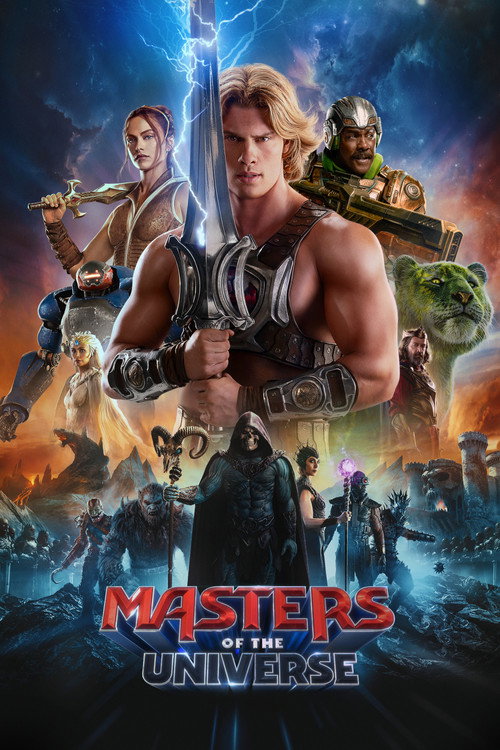
Review of Masters of the Universe by Adam Milton
 Adam Milton
and grade a few things to see how Adam Milton’s taste matches yours.
"To thine own self be true." If there is a movie that embodies that sentiment, at least in a meta sense, it is Masters of the Universe. If you can't appreciate a movie that is unapologetically itself and has no ambition beyond being exactly what it wants to be, then I am not sure you are watching movies correctly.
Masters of the Universe, the intellectual property, is a wonderfully bizarre blend of high fantasy, science fiction, and toy marketing that could only have emerged in the cultural aftermath of Star Wars. Mattel released the toy line in 1982 and, thanks in part to the deregulation of children's entertainment during the Reagan era—which allowed children's television shows to function as extended toy commercials—the company commissioned a cartoon to promote the line. In other words, the toys came first and the story came later. Written primarily by Michael Halperin, the original pitch bible established much of the foundation for He-Man lore.
Masters of the Universe understands this history. More importantly, the film doesn't merely embrace its uncomplicated origins—it revels in them. Why is Skeletor evil? Who cares? Can he be redeemed? Probably not. How do we know he's evil? His face is literally a skull. His henchmen are selfish, ugly, and cowardly. This is not complicated material, so don't overthink it.
What makes the film work is that it never winks at the audience. It never stops to remind you that it is in on the joke. The characters take their world seriously enough that the movie never feels embarrassed by itself, but it also never takes itself too seriously. This is goofy. All of it. And that's okay.
There is a character named Mekaneck whose primary ability is extending his neck. There is another character named Fisto—yes, really—with a giant metal fist that he uses to punch people. What's not to love?
This isn't Shakespeare, and that's exactly why it works.
Travis Knight does an excellent job directing the film. These ridiculous characters look surprisingly natural on screen. He clearly understands how to handle properties like this, having already demonstrated that talent with Bumblebee. Thankfully, the story spends most of its time on Eternia, a world that is warm, colorful, and feels like Frank Frazetta and Liz Frank collaborated on a fever dream. This is a setting where the women are beautiful, the men are larger than life, and every horizon promises danger and adventure.
And this is the first time I have ever thought, said, or written this sentence: Jared Leto was good. He was genuinely good as Skeletor—both funny and menacing whenever the story required it.
Everyone else ranges from good to great. Nicholas Galitzine brings strong comedic timing to He-Man and has chemistry with nearly everyone on screen. Idris Elba is excellent as well, though at this point that almost goes without saying. The enjoyment the cast had making this movie is obvious in nearly every scene.
Where the movie struggles is the script. Clearly written and rewritten over years and held together with studio notes the story is a little all over the place. Some of the questions are best left unasked but some really should have been addressed, mainly how He-Man is presented. Sometimes he seems comfortable in this world destined for his role and other times he is a fish out of water confused by the things everyone else takes for granted.
I don't want to spoil anything, but near the end of the film the characters stand around laughing in the way characters always did at the conclusion of old Filmation television episodes. Cringer—also known as Battle Cat, the elephant-sized feline He-Man rides into battle—looks around in confusion, seemingly wondering why everyone is laughing so strangely.
Moments later, He-Man climbs onto his giant cat and rides off into battle.
If you can't get on board with that, then this probably isn't the movie for you.
Comments
to leave a comment
No comments yet