

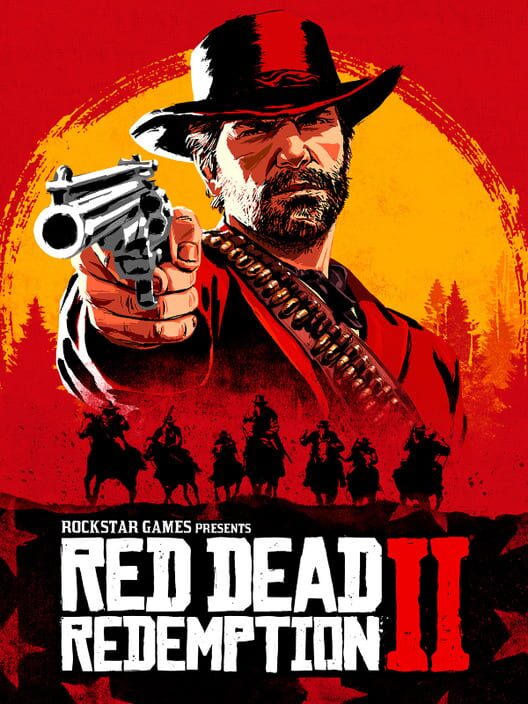
Review of Red Dead Redemption 2 by kenzo
 kenzo
kenzoand grade a few things to see how kenzo’s taste matches yours.
Take a gamble that love exists and do a loving act.
I can't understand how anyone can replay this game so quickly as my first playthrough alone is taking well over 200 hours.
What Rockstar has done here has genuinely changed the way I approach video games as a whole. I'd heard about this game time and time again, so around 2022 I finally gave in and gave it a shot. I'd seen so many edits comparing people's first hours of playing to their state by the end, and I was intrigued by what could possibly be happening in what I wrongly assumed would be some 20-hour game. I came at it reluctantly at first, since it had been gifted to me by a friend, and it just seemed like a long, drawn-out "GTA in the Old West" type of game which was something that, at the time, I didn't have the energy nor the patience for. I've never really enjoyed open-world games with story elements, because they tend to hit a Skyrim-point of never-ending quests with no real payoff for me, so I was originally hesitant to try it. But with RDR2, I decided to sit down alone and give it a real shot, and I'm so glad I did.
I've always loved the idea of a gunslinging cowboy as it makes for great entertainment on its own, but Arthur Morgan and his story are so much more than that. Yes, there are shootouts, bank robberies, train heists, and running from the Pinkertons, but as you get pulled into the story, it becomes so much clearer that this is a tale about a dying Wild West and one cowboy's way of coping with it: having to face the wrong he's done and somehow try to make it right in the end. I love honor-system-based games, and I love even more how much the split-second choices you make during gameplay actually matter — how they let the story hit you that much harder, if you let it.
I gave you all I had.
Arthur, oh Arthur... there isn't a week that goes by where I don't think about this game's story. Arthur is a character strongly based on Doc Holliday, a comparison that becomes clearer the further you get into the game. He starts out as a straight shooter, hardened by his upbringing and the people around him. But by the end, he's a man who is afraid; afraid he made all the wrong choices, afraid he can't make things right, afraid to die. He has to reckon with everything he's done, and the game becomes his slow path to redemption. It's on that path that we're able to humanize this killer, and eventually, to stand beside him, unshaken.
Arthur is such a dynamic character, and you have the choice to make your Arthur take whichever route you desire, but the end is still the same. There's no cheating it. I found that almost profound, in a way. Here I am, going through every nook and cranny trying to bring my Arthur's honor up by helping strangers on the road, giving money to beggars, sparing people I didn't have to, while someone else, playing the exact same game, is inversely robbing lone encampments and setting the inhabitants on fire. And in the end, you both get relatively the same ending. The world doesn't bend itself around how good you were.
I don't know how deep I want to go with this, and I don't want to sound nihilistic, but it's just like life — no matter how good (or bad) you are, it all ends the same. Death comes for everyone, high honor or low. At first that almost bothered me, like what was the point of trying so hard to be good if the game was going to treat me the same either way? But the more I sat with it, the more I realized that's kind of the whole point. The ending isn't really the reward (and this is going to sound so silly), but journey there is. I went out of my way to prolong the game as long as I could for this very reason. The good impact I know my Arthur left on a given town, on Sadie, on Jack, the toymaker, Albert Mason, on the people he helped along every dirt road in the map, that lasts well into the end of the game, even if the game itself doesn't hand you a trophy for it. It's just the small things like that that make me enjoy this game a bit more.
There is one certainty, though: you can't bring back the dead. You can't right every single wrong. No amount of honor, no amount of kindness shown to strangers on the road, can undo what's already been done. The Strange Man will remind us of that, again and again, in that quiet, unsettling way of his. I think it's unsettling because you never know, or find out exactly what you did wrong to summon him per say. With John's story it can be assumed, but for Arthur's, it reminds us that we really don't know about the character prior to his road of redemption.
The Strange Man doesn't offer forgiveness. He doesn't offer answers. He just observes, and lets you fill in the silence with your own guilt or your own peace, whichever you've earned. And maybe that's the real weight of it; in a game so willing to let you chase redemption and chase "being good" he's the one reminder that redemption doesn't erase the past. However, it's what you, the player, make of it. In some small way, he makes us think twice before making our own decisions in life, on that dirt road and off it. Who is your own personal "Strange Man?"
Face me to west so I can see the setting sun & remember all the good times we had.
Red Dead Redemption 2 is a Wild West game, but it's also a game about loss, grief, betrayal, loyalty, and — above all — love. It's a loving game. What you put into it is exactly what you get back. It's silly. It's gripping. It is absolutely heartbreaking. It's human.
Comments7
to leave a comment
Dang, this is a really good review
im completely normal about this game
Well said
Game rules so hard!
That's a lot of words to tell me to play this tonight
Winning hearts and minds