

Review of The Wire - Season 4 by Adam Milton
 Adam Milton
and grade a few things to see how Adam Milton’s taste matches yours.
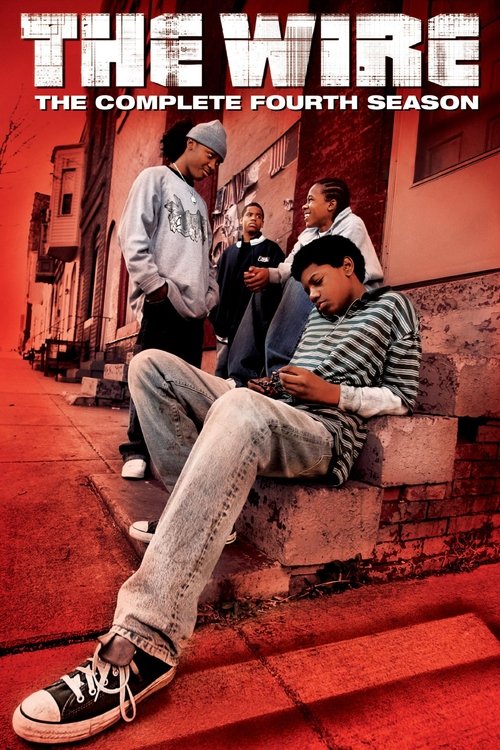
The fourth season of The Wire might be the most ambitious turn any prestige drama has ever taken. In the middle of its run, the show essentially pauses to offer an origin story for half its characters and somehow delivers what may be the strongest season of an already critically acclaimed series. By shifting its focus to a group of middle school boys in West Baltimore, the show exposes the roots of the drug trade and the institutions that quietly shape, funnel, and often fail the city’s children.
After spending multiple seasons with complex, evolving characters struggling against the cold realities of life and a system whose only goal is self‑preservation, we’ve seen how the police, politics, and economics support, feed, fight, and define the war on drugs. This season shows us the origins of the lowest‑level dealers in Baltimore and asks us to watch how characters like Bodie, Wallace, and others might have started.
To a person, the children featured in this season are excellent. They feel at once like children, with the focus and energies of middle schoolers, but also like products of the world they live in. Michael Lee, a serious young man with a sense of loyalty and responsibility, is the perfect example of a child who grew up too fast. He takes care of his little brother and lives with his mother, who is an addict. He also has a stepfather he does not like. Dukie Weems is the often put‑upon and teased son of junkies, and in a world with so little he has even less. Randy Wagstaff is a young man in foster care; he is smart and works hard and seems to have a talent for business. Lastly there is Namond Brice, easily the most despicable of the four young boys: he is cruel, immature, and quick to anger. His insecurity is likely driven by his overbearing mother and his father’s reputation. Namond is the son of the famed Wee‑Bey, incarcerated muscle of the Barksdale organization. Thanks to the debt the Barksdale organization owes his father, Namond lives a much more stable life than the rest.
Roland Pryzbylewski has left the police force and become an eighth‑grade math teacher. There we see him not just interact with the boys, but his story is also used to show the similarities between the police force and teaching. Both institutions are driven by the results of their work, as outlined in statistics. Despite being a math teacher, Pryzbylewski is forced to teach to the statewide tests that will assess the teachers, the school, and ultimately determine how the schools are funded. For a character who was introduced first as a screwup and then as a savant, it’s fascinating to watch him in this environment. He feels natural and grows into the position, adding a connection to the larger world.
Another connection from the previous season is Bunny Colvin. After his efforts to win the war on drugs cost him part of his pension, he works with education academics to study the environment that produces so many hardened criminals and drug dealers. Working in the school, he comes to see the same flaws he saw before: the adherence to procedure and a disinterest in individuals. He works with Dr. Parenti to study the most disruptive students in eighth grade. This is where he meets Namond. After weeks of study, questions, and honest interaction, they both find a sort of kinship. Bunny goes so far as to meet with Wee‑Bey in prison and has one of the most honest conversations in the entire series. Despite Wee‑Bey’s periodic appearances after the first season and his reputation for being a hardened killer, we see a humanity in him a lesser show would never have shown, and his scenes with Bunny Colvin are magnetic.
A character I neglected to mention in my review of the third season was Cutty. An old soldier working for the Barksdale crew, he finds the world has changed and he no longer has the heart to work in it anymore. He retires, with Avon’s respect, and starts a boxing gym, offering to train the youngest members of the drug crews working in Hamsterdam, many of whom are no longer needed as runners or lookouts in that environment. Cutty takes an interest in the boys, showing them the “sweet science” of boxing and using his reputation to move in worlds most wouldn’t dare enter.
One of the kids who rebuffs just about any male authority is Michael. Pryzbylewski, or “Prezbo,” as his students affectionately come to call him can’t reach him through regular means. Marlo attempts to gain favor with the kids in the neighborhood by handing out money, and Michael rejects him. Cutty attempts to help, time and again, and almost loses his life, but each time is rejected. Michael’s backstory is dark and heartbreaking, but Tristan Wilds plays his rage and contempt with a subtlety befitting an actor with decades more experience.
In the earliest seasons of The Wire, I felt the show merely presented the ills of this world. The third season was a shift; there was a direct message about how the war on drugs could be honestly combatted. This season shows us the very roots of the system. Social promotion, truancy officers, and school violence are all par for the course. None of the teachers are as cynical as the police, but they are no less stuck in the same system as everyone else.
Season four is heartbreaking. You see the young men attempting to make their way in the world and being used by school administrators or drug dealers for their own ends. Their education suffers at the hands of state testing. Their parents fail to protect them. They are also at the mercy of their peers making for an environment that is almost impossible to survive. These kids suffer but are so young they don’t even know they should be treated better. There are so many nuanced, blink‑and‑you’ll‑miss‑it moments that fully flesh out this world. Actions that seem harmless at the start become devastating by the end of the season. A character is forced into cooperating with the school administration and that labels him a snitch and by the end of the season he has paid for that reputation more than once. What started as a principle asking questions ends with someone who cannot be saved, even with the best intentions.
Taken in parts or as a whole, season four is the very best of the entire series. As a single chapter, it shows us how drug dealers might be created, tracing the path from classroom to corner with unflinching clarity. There are scenes in the season too that are among the very best of the series. Wee-Bey and his wife, Namond’s mother. Cutty reaching out to Micheal. Michael and Chris’s conversation that would leave inattentive people confused. Along the way, fan favorites meet their end, characters grow and change, and the world of The Wire only grows deeper and richer. It’s not just great television; it’s a devastating, necessary look at how a city manufactures both its casualties and its criminals, often starting with kids who never had a chance.
Comments1
to leave a comment
The best show of all time, and this is its most nuanced and impactful season. Great review. You nailed it.