

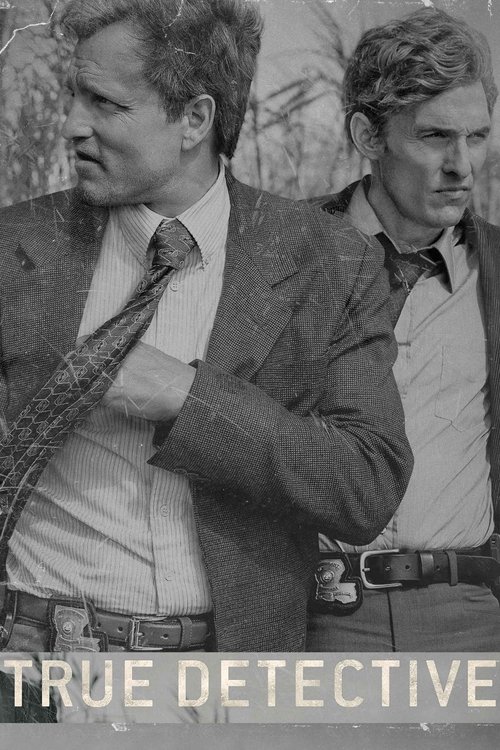
Review of True Detective - Season 1 by Adam Milton
 Adam Milton
and grade a few things to see how Adam Milton’s taste matches yours.
Sometimes you see a trailer and you just know a TV show or movie is going to be not just good, but feel tailor-made for you.
That’s how I felt when I saw the True Detective trailer, with Alex Clare “Whispering” ominously playing in the background.
Told through a nonlinear narrative, True Detective season one explores Rust Cohle and Marty Hart’s memories of their investigation into the murder of a young woman, Dora Lange, from 1995 to 2002. They must revisit the investigation ten years after it was deemed closed, as new evidence reignites interest in the murder and the investigators. Both men are interviewed by new detectives who want to rehash the investigate as much as the case itself.
The story also explores the personal lives of the men as they investigate the murder. Marty, played by Woody Harrelson, appears at a glance to be a classic family man. As the season progresses, he is shown to be lazy and adulterous, and his love for his family is steeped in misogyny. When his wife asks for his help or simply wants his presence, he does so only begrudgingly. Marty is an intelligent man and a talented detective, but he is an indolent and uncurious man. He will run down a case, investigate leads, and interrogate suspects, but when his family needs more than the cursory attention of a father, he does as little as he can.
Rust, on the other hand, is a man beset by personal tragedy and professional hardships. His daughter died in a car crash before the start of the show, and that heartbreak resulted in his divorce. He spent more time undercover as a drug dealer than would normally be allowed, and that stress fed his ego but also left scars he never seemed to address. He is at least as smart as Marty, but more academically inclined and introspective. Where Marty is content with what he sees in his personal life, Rust cannot be. He quotes Nietzsche and spends time ruminating on the nature of humanity, God, society, and just about anything else that crosses his path.
What’s fun about the interplay between Rust and Marty is that they are both great at their jobs. Their skills complement each other, and they seem to know and understand each other, at least professionally. They just don’t like each other though by the end of the season they seem to know that they need each other. The chemistry between Woody and Matthew sizzles on screen, and with different lighting and other narrative framing, some of their arguments would be straight out of a dark comedy.
Set at the edges of the modern world, Marty and Rust travel through the blighted and neglected parts of rural Louisiana to investigate the murder. In that decay, you don’t sense evil as much as you feel an absence of morality—a deep well of apathy and powerlessness.
This is a world where people accept what they see and the world as it is. They know about brothels where girls barely into high school work, men cheat on their wives and brag about it, people dole out personal justice, and everyone kowtows to the powers that be. In that absence, evil is allowed to fester. Everything in the story reflects that, and by the end of the season, you are left with the distinct feeling that they may have solved the case, but not the men who allowed that evil to persist. In a lot of way this season feels like a earthy Lovecraft story. Instead of the evil being creatures from the void it is the malignant cruelty of indifference.
As a single season of TV, the first season of True Detective is on my short list of the best TV seasons ever. Rarer still is for a TV show to start off so incredibly. From the writing, acting, and directing to all the unnoticed efforts that go into making a TV show, True Detective is truly exceptional.
Comments13
to leave a comment
I need to watch this one. The Arctic one was great but haven't seen the earlier seasons.
Season 1 is worth the hype.
Refreshing to read! I also think TD Season 1 is one of the best single season shows I've ever seen. I remember my wife and I watched the first episode after dinner one night and we finished the show at about 5 a.m. the next morning. We both had to work that day and didn't even care. If I find a single season show on the same level of Season 1, I will scream it from the mountain tops.
Thank you
I love the season with Jodie Foster, but all seasons pale in comparison to the 1st.
My wife and I watched season 4 and I definitely had mixed feelings on it. It might warrant a rewatch and a review.
It took us two watches to fully understand and appreciate it. It's not the best season of TV, but it's still solid
The Jodie Foster season is easily my second favorite also
I still have two episodes left to finish of season 1. Was super invested, got distracted by something else, and never picked it back up. I will come back to this after finishing
This is a series that I rewatch every 2-3 years. I am curious to see what you think when you finish it.
Nice review, man. I think it's one of your best.
One of the best agreed. The other seasons are a mix bag but to be fair they started with something that was pretty much impossible to top
I watched an episode and a half of season 2… Couldn’t finish season 3 despite Mahershala being one of my favorites. Season 4…I might need to review that one