
 PurelyHated305
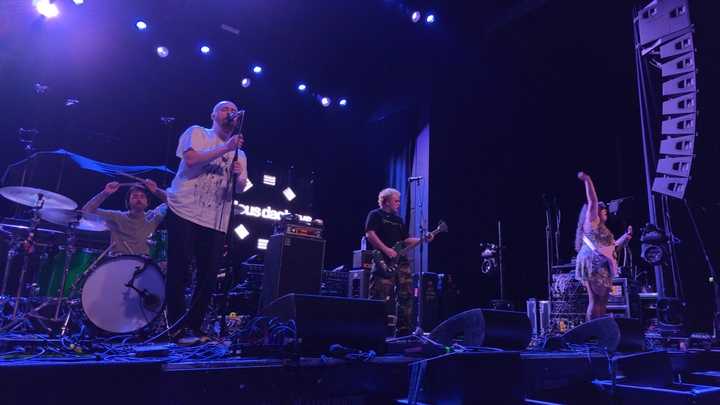
Drop the needle on the first forty-five seconds of The Callous Daoboys, and you aren’t granted the courtesy of a clean entrance. No polite four-bar drum cadence, no sanitized synth riser warning you to brace for impact. They shove you headfirst into a meat grinder: full-throttle blast beats and unhinged shrieks tearing across a suffocating, discordant wall of guitar noise. Before your brain can even map the wreckage, they cut straight into a filthy breakdown twenty-three seconds in, pivot on a dime into a glitchy, dance-driven pulse with guitars still snarling over top, and detonate into another vicious hit by the forty-four-second mark.
It is a clinic in pure kinetic whiplash. Your eyes widen, your jaw drops, and you scramble to process the violence of what just happened. That is the power of a genuine “what the fuck” moment in heavy music, an ambush that feels volatile, dangerous, and completely unconcerned with your comfort.
Now compare that to the darlings of social media.
When a band like Sleep Token executes a genre shift, the reaction isn’t a startled “what the fuck.” It’s an exhausted, hollow “why the fuck?” You get four minutes of breathy, faux-R&B crooning over an 808 beat, then an abrupt, mechanical lurch into an eight-string djent riff that shares zero thematic, harmonic, or emotional DNA with what came before. It’s the sonic equivalent of slapping a 1970s funk lick onto the back end of a progressive metal track, a stunt Sleep Token literally pulled, not because the music earned it, but to break the fourth wall and beg the audience to notice how clever they are. It’s forcing a square peg into a round hole so people can say, “Look what we did.”
That is the fundamental lie poisoning modern heavy music: the idea that any experimentation is good experimentation, and that the spectacle of genre-hopping matters more than the integrity of the song itself. The industry has mistaken collage work for songwriting. When Sleep Token or standard playlist-core acts abruptly jump genres, the forward momentum completely flatlines. It derails the energy like throwing a mid-tempo alternative crawl into the middle of a high-octane hardcore bill. The pulse drops through the floor, the adrenaline evaporates, and an otherwise exciting track instantly becomes contrived, predictable, and boring.
The feedback loop feeding this disease is obvious. Content creators don’t get clicks for dissecting whether a track possesses structural tension or cohesive narrative weight; they get clicks by pulling theatrical, cartoon stank faces at a scheduled timestamp for TikTok and YouTube reaction videos. The audience, desperate to convince themselves they’re witnessing a boundary-pushing revolution, mistakes a superficial costume change for visionary art. They celebrate the sheer shock of novelty rather than earned emotional release.
On the other end of the assembly line sits the corporate sanitization of the genre, perfected by bands like Bad Omens. Here, experimentation is discarded entirely in favor of an air-conditioned conveyor belt: the ethereal, breathy verse tailored for social media, the massive, soaring pop-gloss chorus, the obligatory verse-chorus repeat, the scheduled breakdown featuring droning, stale power chords, and the final radio-ready hook that sends the listener home unbruised. These breakdowns carry no dirt, no sweat, and no human hands worked to the bone. They are obligations checked off a corporate marketing deck.
And the result of all this sterile gloss and disjointed novelty? It makes you feel absolutely nothing.
Music should be participatory. Music should be an emotional reckoning. It should provoke love, euphoria, disorientation, or pure hatred. Indifference is the ultimate death sentence for heavy music. Listening to an aggressive record and feeling completely numb is a far greater tragedy than listening to an ambitious failure. I would rather violently despise a record for taking a disastrous leap than shrug off another hour of focus-grouped background noise designed for streaming playlists. I can respect ambition with purpose. I can respect a band doing what they do best (looking at you, August Burns Red). I can’t respect sterility, and I can't respect a cheap gimmick masquerading as high art.
If you want to understand what heavy music sounds like when the artists actually bleed for it, you have to look outside the algorithm. Look at Boundaries, a band that wears its pedigree on its sleeves and fundamentally understands the razor-sharp tension of early metalcore. They build songs around a relentless push-and-pull. Dual vocals tearing their cords apart, a rhythm section that caves your chest in, and chainsaw guitars spitting hot oil. When Boundaries incorporates melody, it isn’t a commercial break or a pop quota; it is desperate, suffocating, and carries the exact same emotional terror as their heaviest breakdown.
They aren’t alone in keeping the bloodline alive. Knocked Loose doesn’t need a polished hook to pack arenas. They do it by dragging uncompromising, abrasive violence onto the biggest stages in the world. Johnny Booth constructs tracks with an urgent, restless fury where every technical turn feels earned rather than displayed. Look at the raw, volatile legacy of bands like Seizures before their implosion(to say the least), the sheer bludgeoning weight of Varials, the dark, razor-sharp precision of Currents, the unhinged catharsis of Dreamwell, or the suffocating, emotional violence channeled by Wounded Touch.
These bands understand what the novelty chasers never will: genuine experimentation doesn't mean wearing four different genre costumes in a single track to beg for applause. It means locking into a pulse, refusing to let the momentum die, and writing songs with enough teeth to leave a permanent mark. If heavy music isn’t willing to make you bleed, it isn’t heavy. It’s just a product.
Comments13
to leave a comment
I actually agree with a lot of what you’re saying, especially when it comes to the TikTok-ification of metalcore and how people treat every genre switch like it’s some revolutionary moment in music. But I think using Sleep Token as an example of what’s ruining the genre is a little disingenuous. Vessel has specifically expressed that he doesn’t want their music confined to a genre because that’s not really the point of what they’re creating. And I think that’s where the whole argument about forcing a square peg into a round hole becomes a little ironic with all due respect. Both the haters and the glazers are doing exactly that. One side is desperately trying to prove they’re musical geniuses, while the other is trying to hold them to the standards of a genre they aren’t necessarily trying to represent. And I think there’s something to be said about the identity they’ve created. Sleep Token isn’t just throwing random genres together for the sake of being different. Whether you think they execute it well or not, there’s clearly an artistic vision behind their music, imagery, and storytelling. We don’t criticize Coheed and Cambria for building their music around an overarching narrative and the world of their comics, so why is Sleep Token’s approach suddenly treated like some cheap gimmick? You can absolutely argue that the execution doesn’t work for you, but I think dismissing the entire concept as artificial or attention-seeking is unfair. And this is coming from someone who genuinely hated Sleep Token for a long time. But once I actually sat down and gave them a fair listen, I started appreciating what they were trying to accomplish. I don’t think everything they make is incredible, and I definitely don’t think they’re reinventing music, but I can respect a group of artists doing something different because it’s what they WANT to create. My biggest issue is that Sleep Token has become this convenient punching bag for problems that existed in metalcore LONG before they became popular. The genre was already moving toward polished production, accessible songwriting, and mainstream appeal(thanks BMTH). Blaming a band that doesn’t even seem particularly interested in being categorized as metalcore for that shift feels misplaced. And honestly, I think the Sleep Token glazers are just as cringey as the haters. Both sides have turned the band into something bigger than the actual music. One side acts like they’re the second coming of Christ, and the other acts like they’re personally responsible for the downfall of heavy music. I think your overall point about authenticity is fair, but authenticity doesn’t have to sound a certain way. A band making abrasive, chaotic music isn’t inherently more genuine than one making something polished, atmospheric, or accessible. Sometimes the most authentic thing an artist can do is make exactly what they want, even if it doesn’t fit neatly into what everyone else expects. At the end of the day, if you don’t like Sleep Token, that’s completely fair. Music is subjective. But I think there’s a difference between criticizing music for not resonating with you and treating the artists themselves as symptoms of everything wrong with a genre. I hope this comes across as respectful and non-argumentative as possible. You made a great post and you make super valid points! I just feel the need to speak on Sleep Token a little.
I understand your sentiment, but using what the singer states the band is doesn't automatically negate anything I said. What I'm inferring by the phrase "square peg in a round hole" has nothing to do with the band's "artistic vision." Whether that was their intent or not has nothing to do with the idea that every idea is shoehorned together. And considering we have numerous masked bands popping out of nearly every corner of the world(many of them emulating what Sleep Token is doing), I would say they have had a massive impact on the neutering of the genre as a whole. You cannot ignore the impact just because you enjoy their sound. I understand 100% what you're getting at, I just respectfully disagree. But as you said, we love what we love, and we can't help it.
I think the reason I feel the sentiments of the band matters more to me is because of intent itself. When I first heard Sleep Token I didn’t say “oh wow this is so metal”. I heard an alternative band. The ONLY reason I hear about them in metal community is because people argue over if they belong there or not, and the band spoke on that themselves and said they don't. So thats why I think lumping them in metal is in of itself super subjective, let alone point to them being pointed at as a reason for the failure of a genre. For sure I get that, they may have changed things and influenced them greatly. What I'm saying is thats a result of the fans, and people who dislike them, more than the band themselves. It is super subjective so for sure we have to agree to disagree. For another bad example, if I convince my coworkers that a hotdog is a sandwich, and I really hammer down on how shit of a sandwich it is..it just doesn’t make sense ya know? Maybe I cant articulate this well because its stupid but if I put a label on it, and then fault it for the label that I myself put it in, it sounds more like I just really hate hotdogs ya know? Lol @electricsheep please don’t bust my chops too hard
I get what you're saying 🤣🤣. You're good. I just find what Sleep Token does to be derivative of every genre the mash together. I loved The Summoning until the left field turn at the end. It felt like they just slapped some funk in there as like a "wink, wink" and they just lost me.
Haha all good, it’s all love. I love that what you mean though, I got away from Metalcore around 2014 just because it didn’t have that magic anymore. It WAS the best genre for me at a time and super sentimental to me, so I loved your post on it.
There has been about 4-5 years up until recently that I had distanced myself from it entirely. Needed an identity crisis to find it again 🤣🤣
I also disagree with the Coheed comparison. Coheed didn't slap a conceptual comic book skin over disconnected Spotify-core trends. Claudio Sanchez writes sprawling prog-rock/post-hardcore movements where every riff, key change, and melodic motif serves the architecture of an actual, cohesive song. The narrative world-building works because the musical foundation underneath it holds water on its own without needing a gimmick to justify the track’s existence.
Okay yeah I can see what you mean. I think your opinion holds more weight here, it may be a bad comparison, I was hoping to highlight the similarities in the creative narrative that is a driving force for the music. I definitely get what you mean.
Major agree. I do wonder how much of it is bleedover from modern EDM DJs. When I was mixing sets I'd go for cohesion and occasionally switch genres or tempos if it fit in the set. Not that I was like some amazing DJ or whatever, but it just made sense for the hypnotic styles I would play. But the biggest local DJs (and a lot of the touring DJs for that matter) would always try and be abrasive. Like slamming tempo changes from riddim into jump up or just doing pop punk vocals over a three-track riddim chop. I know there were a lot of people in the metalcore/deathcore to EDM pipeline, so maybe people like Sleep Token saw that opportunity and capitalized on the familiar.
My biggest issue is the "TikTok-ificiation" of it honestly. If we didn't have this slew of disingenuous reaction videos, I do believe it wouldn't be nearly as dire as it is. There are plenty of amazing bands in the "underground(Dreamwell, Boundaries, and Wounded Touch come to mind specifically)", but the mainstream of metalcore would rather be played on Octane than elicit a real emotional response.
Adrenaline is certainly easier to pump up rather than other emotions. Metalcore in its hair metal era?
Bring back the swoops!
@MonkeyDPoopy gonna be big mad about the Sleep Token hate