

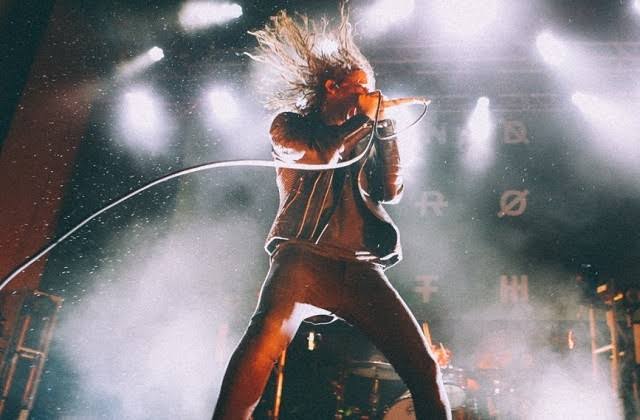
What Happened to Our Underoath
 PurelyHated305
and grade a few things to see how PurelyHated305’s taste matches yours.
I don't want Underoath to make Define the Great Line again. I don't need them to recreate 2006. I don't need them to dress the same, believe the same things, write the same riffs, or pretend twenty years of life haven't happened.
I just miss when their music sounded like they gave a fuck.
That's the part I keep coming back to whenever I try to figure out why post-reunion Underoath bothers me so much. The easy explanation would be nostalgia. I'm 43. Define the Great Line was a formative record for me. It was there during a period of my life when I needed something that sounded as desperate and unstable as I felt. Of course I have an attachment to that version of the band.
But nostalgia doesn't explain it.
Underoath spent most of their career changing. That's part of what made them special. The earliest version of the band was built around huge breakdowns, an almost black-metal-like atmosphere, and vocals that were barely decipherable. The Changing of Times brought in huge hooks, clean vocals, and even stranger electronics. They're Only Chasing Safety ripped away some of the abrasive edges and leaned into pop structure and massive, anthemic choruses.
Then Define the Great Line changed everything again.
The angular guitars came back. The abrasion came back. The atmosphere became enormous. But they didn't throw away what they'd learned about writing songs. Those big choruses and more accessible structures were still there, except now they were surrounded by dread. Hope existed, but it had to fight its way through everything else to reach you.
Lost in the Sound of Separation pushed that atmosphere even further. Songs felt like they eventually collapsed under their own weight, and I mean that as one of the highest compliments I can give them. Then Aaron Gillespie left, and Disambiguation became something else entirely. Much of the triumphant, anthemic energy disappeared. In its place was something suffocating, angry, and claustrophobic.
Every one of those records sounds different. Every one of them still makes sense as an Underoath record. That's why "they changed" has never been a convincing defense of Erase Me for me. Change was never the problem.
When SiriusXM debuted "On My Teeth," I remember driving around and immediately feeling uneasy. Aaron was back, which should have felt like a homecoming. Instead, I heard power chords where I expected angular guitars. I heard something purposefully anthemic where I expected instability. There was atmosphere, but for the first time in this band's career, the atmosphere didn't seem to do anything. It was just there.
And then Spencer Chamberlain yelled "fuck."
I'm not Christian. I don't care that Underoath isn't a Christian band anymore. Do you, guys. But hearing it was still strangely jarring. This was a band that had once been a beacon of the Christian side of the genre, and suddenly rejecting that identity felt almost as prominent as the music itself. The weird thing is that the profanity didn't make the song feel more dangerous. It made it feel safer. I played "On My Teeth" over and over for days, trying to convince myself Underoath was back.
They were indeed not back.
When Erase Me arrived, all of those fears became the record. It felt sterilized. Arena-sized. Generic in ways Underoath had never been generic before. The band had already proved with They're Only Chasing Safety that they could embrace pop structures without sacrificing their identity, and with Define the Great Line that accessibility and abrasion could live in the same room. This wasn't that. To me, it sounded like radio rock wearing pieces of Underoath's wardrobe.
And maybe the most frustrating part was that the entire thing felt performative. Again, the problem wasn't that they had abandoned Christianity. The problem was that "we aren't that band anymore" seemed to become part of the presentation itself. The musical and philosophical shifts seemed to make the same announcement: look how different we are now.
Different isn't automatically interesting, and reinvention isn't automatically evolution.
Voyeurist was better. Some of the screaming came back. Some of the angular guitar work came back. Some of the atmosphere started creating pressure again. There were moments where I could hear the old Underoath DNA fighting its way through the newer version of the band. "Cycle" was the song that really pulled me back in. It was heavy. It was suffocating. Spencer sounded feral in places. For a moment, I thought: there they fucking are.
Then Ghostemane started rapping.
I don't have a problem with rap. I love bands that combine heavy music with hip-hop when the combination feels organic. My problem was that this didn't. It felt grafted onto a song that didn't need it, like another idea had to be introduced simply because another idea could be introduced. That's the distinction I keep landing on with current Underoath.
Experimentation works when it expands a band's language. It fails when it sounds like the band is borrowing somebody else's vocabulary simply to prove they can, and that's where compromise starts to become the bigger problem. If Underoath wants to completely alienate the people who grew up with the old records, then fucking do it. Make the statement. Plant the flag. I might hate the record, but at least I'll respect the conviction.
I don't like wishy-washy music.
What I hear instead is a band caught between two eras. They seem to have an idea of where they're going, but no clear path to get there. Pieces of the old identity return, but they sit beside ideas that, to my ears, don't naturally belong. The result isn't a bold new Underoath or the Underoath I remember. It's something suspended between the two. That's why I don't think bands need to "stay the same."
I don't even necessarily tie identity to a particular sound. Every band's identity is different, or at least it should be. Sometimes it's a guitar tone. Sometimes it's a vocal dynamic. Sometimes it's how they arrange songs, a philosophy, a sense of humor, or simply how the musicians present emotion.
For Underoath, three things feel especially important to me.
The first is contrast in the vocals. Certain bands need harsh vocals because the push and pull is fundamental to the music. When two vocalists occupy the same melodic space, that tension disappears.
The second is restraint with the electronics. Chris Dudley is fantastic at what he does, but atmosphere used to strengthen Underoath songs. It created dread. It made the heavy parts feel larger. It made the quiet moments feel unsafe. I don't need full songs dominated by atmosphere simply because atmosphere is part of the band's vocabulary.
And the third is aggression. Underoath can be melodic. They can be polished. They can be anthemic. They can be weird. But if the aggression disappears completely, I don't know what I'm listening to anymore.
Maybe the simplest way to say it is that Underoath's identity was never one sound. It was contrast.
Clean and harsh. Hope and dread. Melody and abrasion. Atmosphere and impact. The band could move those pieces around however they wanted and still sound unmistakably like themselves.
That's also why the Observatory performances during the pandemic frustrated me more than almost anything they've released since reuniting. When I heard their live version of "Returning Empty Handed," I felt it again.
That was the Underoath I remembered.
The tension was there. The atmosphere had purpose. The aggression felt dangerous. The entire performance sounded like something was coming apart in front of me. And that's when the obvious question became impossible to avoid:
If you can still access this part of yourselves, why does so little of the new music access it?
That's the feeling I want from heavy music. I can't perfectly explain what it means for music to come from "inside" somebody. I just know when I hear it. I've heard vocalists sound so tortured that I've nearly gotten choked up. I've heard guitars communicate more desperation than lyrics could. I've heard drums feel less like percussion and more like a pulse racing toward something. That's the beauty of this kind of music. The emotion is right there at the front. You can't avoid it.
And I feel nothing when I listen to most of Underoath's newer material.
That doesn't erase what came before it. Define the Great Line will always be one of the most important heavy records of my life. I can't retroactively remove what that album meant to me. But it has changed my relationship with the band that exists now.
Twenty-five-year-old me would have happily thrown down stupid money to see Underoath with August Burns Red and Emery. Forty-three-year-old me has trouble rationalizing the same thing even when the band is playing Define the Great Line in its entirety. Take age, money, and adult responsibility out of the equation, and the reason becomes uncomfortable:
I don't feel as invested in current Underoath as I once did.
Back then, their evolution felt natural. Each record seemed like the place the music itself had pulled them toward. Now, I hear something more calculated. Not necessarily cynical, as I can't know their motivations, but music that feels increasingly designed around what might appeal outward rather than what needs to come out from within. And maybe that's the question every legacy band eventually has to answer when it decides to come back.
What are we doing here?
Do we really have something left to say?
Is what we're saying important?
If the answer to either question is no, maybe it's okay to leave the ending alone.
Fans deserve some blame for the impossible expectations we put on reunited bands. We demand that they evolve, then complain when they change. We demand the old songs and then accuse them of being nostalgia acts. But bands still have to decide why they're reopening something that already had an ending.
I don't want Underoath to make Define the Great Line 2.
I don't want them to pretend they're twenty-five again.
I want them to do whatever the fuck they want.
Make something that makes my eyebrows go up. Make something that immediately puts that lump in my throat again. Make something ugly, beautiful, melodic, abrasive, electronic, accessible or completely fucking bizarre. Just make me have an emotional response. Because Underoath already proved that reinvention doesn't have to mean abandonment.
So why are we testing that theory now?
I miss when your music sounded like you gave a fuck.
If you want more of this kind of writing, you can find it at 305HxC.com
Comments4
to leave a comment
Great writeup man. I've never really gotten into Underoath although they've been a part of my musical consciousness ever since I started listening to metal as a teenager. They were just too massive to ignore. Really dug Disambiguation though for all its grittiness. Heard some of their newer stuff and couldn't believe it was the same band lol In a way it makes me glad that some of my favorites aren't coming out with new music. Can you imagine how bad a new SOAD album would probably be with their drummer being an outright Trumpist and then Serj trying to keep the peace and censoring himself? Awful to think about. For some bands a better solution is just do limited blockbuster tours or one-offs and ride their past work into the sunset. Maybe Underoath should have gone that route.
Very important band for me. DtGL is a constant in my life, so their reunion was underwhelming, to say the least. But thank you!
Yee that's a bummer. Maybe I'll have to check out more of their old stuff. Probably should just for the sake of rounding out my metalcore.