

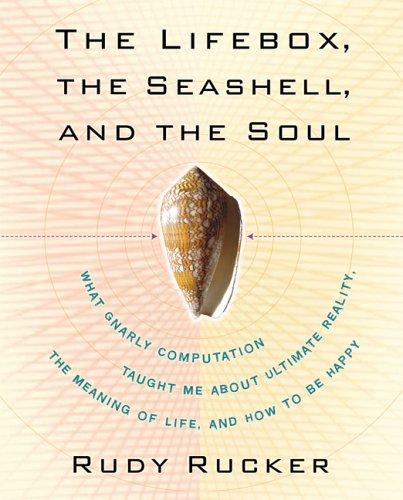
The Lifebox, the Seashell, and the Soul: What Gnarly Computation Taught Me About Ultimate Reality, the Meaning of Life, and How to Be Happy
Rudy RuckerThe Lifebox, the Seashell, and the Soul: What Gnarly Computation Taught Me About Ultimate Reality, the Meaning of Life, and How to Be Happy
or to grade, review, and add to your backlog.
Description
A journey of a thousand miles begins with one step, goes the ancient saying. This concept is at the root of the computational worldview, which basically says that very complex systems — the world we live in — have their beginnings in simple mathematical equations. We've lately come to understand that such an algorithm is only the start of a never-ending story — the real action occurs in the unfolding consequences of the rules. The chip-in-a-box computers so popular in our time have acted as a kind of microscope, letting us see into the secret machinery of the world. In Lifebox, Rucker uses whimsical drawings, fables, and humor to demonstrate that everything is a computation — that thoughts, computations, and physical processes are all the same. Rucker discusses the linguistic and computational advances that make this kind of "digital philosophy" possible, and explains how, like every great new principle, the computational world view contains the seeds of a next step.
Community reviews
No reviews yet. Be the first to review this book.
More like this

Geometric Mechanics and Symmetry: The Peyresq Lectures
James Montaldi
Image-Based Fractal Description of Microstructures
J. M. Li

Introduction to Mechanics and Symmetry: A Basic Exposition of Classical Mechanical Systems
Jerrold E. Marsden
Useless Arithmetic: Why Environmental Scientists Can't Predict the Future
Orrin H. Pilkey

From Here to Infinity: A Vision for the Future of Science
Martin J. Rees
How It Ends: From You to the Universe
Chris Impey
Feynman's Rainbow
Leonard Mlodinow

Dezessete equacoes que mudaram o mundo
Ian Stewart