

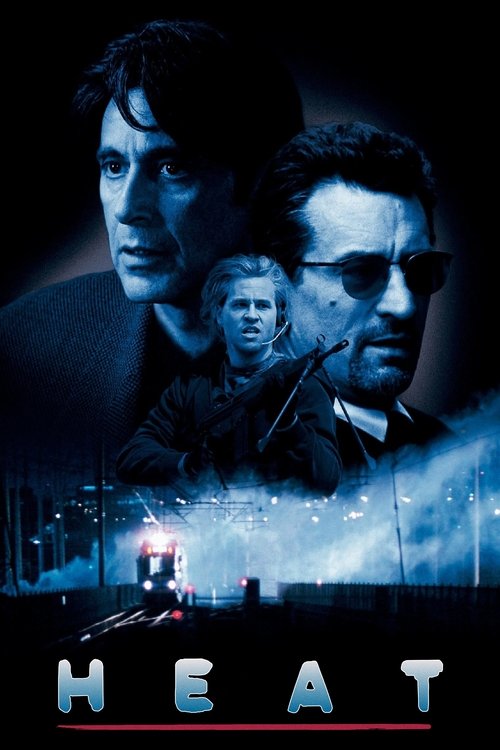
Review of Heat by Adam Milton
 Adam Milton
and grade a few things to see how Adam Milton’s taste matches yours.
Every once in a while, a movie seems perfectly made just for you. All of the things you can't get enough of, all of the things that hit that perfect spot.
Other times, movies are simply made well. Nothing created by humans is beyond reproach, but some movies are so good that they escape their genre trappings and bleed over into the zeitgeist.
In the Venn diagram of movies that are both my favorites and exceptionally well made, Heat exists in the overlap.
Set in 1990s Los Angeles and centered on a world of professional crime, Heat follows two men: one a criminal, the other a law enforcement officer. Each is trapped in the orbit of his own professional obsession as they go about doing their jobs.
Neil McCauley, played by Robert De Niro, is a veteran of countless heists who has spent time in prison. He is calm, skilled, and disciplined. He lives his life by one simple rule:
Don't let yourself get attached to anything you are not willing to walk out on in 30 seconds flat if you feel the heat around the corner.
That philosophy influences his entire life. His house is devoid of the furnishings that would turn it into a home, and he has no meaningful romantic relationships. The closest thing he has to friends is his crew, played by Val Kilmer, Tom Sizemore, and Danny Trejo. They work together like cogs in a clock, each perfectly positioned, moving smoothly and without hesitation.
His crew runs into trouble when they allow a newcomer to join a job. Kevin Gage, playing Waingro, is a violent adrenaline junkie who makes exactly the kind of mistake Neil prides himself on never making. That mistake draws the attention of Vincent Hanna.
Vincent Hanna is a detective in the famed LAPD Robbery-Homicide Division. Just as dedicated to his profession as his foil, Hanna differs from Neil in one important way: rather than avoiding attachments, he neglects them. He is on his third marriage and has a stepdaughter he barely has time for. He also has a "crew" of sorts—a team of detectives who are no less dedicated to their profession, played by Ted Levine, Wes Studi, Jerry Trimble, and Mykelti Williamson.
Set against the warm indifference of Los Angeles, these two teams, operating at the height of their professional abilities, work against each other. No foolish mistakes. No unnecessary pride. No wasted movement. Like the best championship games, no quarter is given and none is asked.
Heat is as much a character study of men and their professional ambitions as it is a story about cops and robbers. The movie takes great pains to show us how each crew operates and the logic behind their actions. They conduct research, perform stakeouts, study their targets, and use every skill and tool available to them to gain an advantage. As the movie moves along these men even break their own rules as their worlds collide and change forever. It is in that complication you start to see more of the similarities between Neil and Vincent.
Even the violence feels professional. While there is plenty of gunplay, the action never feels gratuitous. And I would be remiss if I didn't mention the often-mimicked but never truly replicated downtown Los Angeles shootout. It is still just as spectacular as it was in 1995.
Michael Mann has attempted to recreate Heat's tension, character studies, and gun battles in Public Enemies, Collateral, and Miami Vice, but he has never quite managed to stick the landing in the same way.
Heat is a high-water mark in filmmaking. There is a reason so many of the very best people in the industry admire it. It isn't simply a great crime movie. It is a movie about people who are exceptionally good at what they do and the sacrifices they make to remain that way. That's why Heat sits in the overlap of my favorite movies and the movies that are simply made exceptionally well.
Comments
to leave a comment
No comments yet