

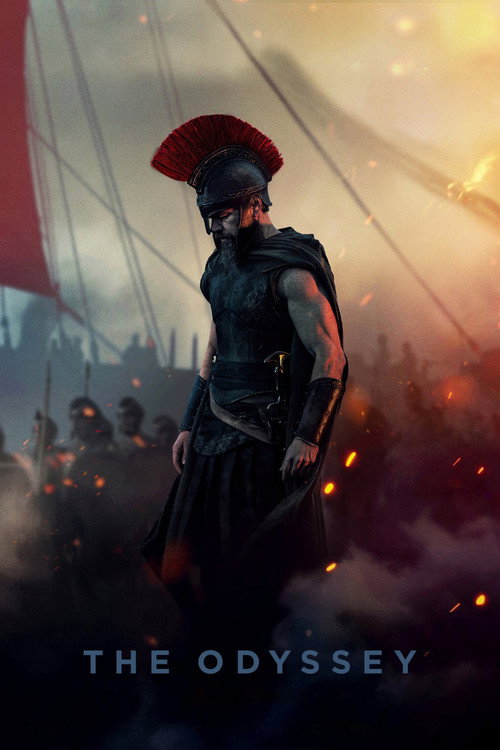
Review of The Odyssey by Adam Milton
 Adam Milton
and grade a few things to see how Adam Milton’s taste matches yours.
Christopher Nolan is gonna Christopher Nolan or, more succinctly, a leopard doesn’t change its spots.
I like Christopher Nolan as a filmmaker. We seem to share the same tastes and interests, given his increasingly prolific oeuvre. His films are never boring, and he approaches them with an earnestness that is refreshing. He is invested in storytelling but demands that the audience meet him where he is, though where he is is never out of reach. What I appreciate most is his love of the art of film making. His use of lighting and practical effects is second to none. In a world of cheap and rushed CGI, it’s great to see a filmmaker who both believes in forced perspective and has the cachet to get that made.
I think it’s better to think of this movie as Christopher Nolan’s The Odyssey instead of simply The Odyssey. All of the trappings and stylistic choices we have come to associate with a Nolan film are here. You know what this movie looks like, what it feels like. I would never describe a Nolan film as warm; this might be as warm as he’s ever done. If you are going to show the Mediterranean, I guess that can’t be avoided.
The film is told through flashbacks but mostly follows two tracks: one follows Odysseus and his crew making their way back home, and the other focuses on Penelope and their son Telemachus, both harassed by suitors. These men are more after the throne of Ithaca than the love of Penelope. In typical Nolan fashion, the balance of these two tracks is well handled and well-paced.
I avoid spoilers in most of my reviews because I want you to experience the film as I did. What sets this film apart, for me, is the interpretation that Nolan adds. A subtle refocusing and highlighting of the story changes so much of it and adds a layer of nuance and timelessness that makes the film worth seeing. Honestly, the more I thought about the film, the more I loved it.
I won’t debate the casting choices here, but everyone brought their A-game. No performance was lacking or half-hearted. Anne Hathaway infuses Penelope with a grace and strength that might have gone unnoticed in a lesser film. Elliot Page, brief as his time on screen is, anchors my favorite part of the film. The lighting and atmosphere in that sequence are both haunting and aching with importance and regret, and Elliot rises to the occasion, reinforcing a layer of the film that pushes it all over the top. James Remar is also in that scene, and I didn’t recognize him at first; despite that, his short time on screen is memorable.
The creature design is appropriately believable and monstrous. Sorry for the spoilers for a epic that is 3000 years old but the scene with the Cyclops is perhaps the most tactile in the entire movie. While the visual design is grotesque the sound design of the creature is haunting. The other monsters, Laestrygonians, Sirens, Scylla and Charybdis, have great designs and feel as varied as nature might produce.
If Ludwig Göransson has ever delivered anything less than an A– score, let me know, because I haven’t found it. Through my research for this review I learned that Ludwig worked with experts to make and use era appropriate instruments. He should win his 4th Oscar for his work.
When I walked out, I enjoyed the movie but felt that seeing it once was enough. It has been less than 24 hours, and the movie has only grown on me. The cinematography held my rapt attention so completely that the elements of the story which add depth and dimension to a tale as old and foundational to the Western literary canon only surfaced in my mind in the hours—and surely days—after my first viewing.
This movie is excellent and more than worthy of your time. I don’t just recommend seeing this, I recommend experiencing this in a theater.
EDIT: I added some thoughts on the creatures.
Also reviewed by One AnotherF, Electric SheepB+ and kenzoA
Comments
to leave a comment
No comments yet