

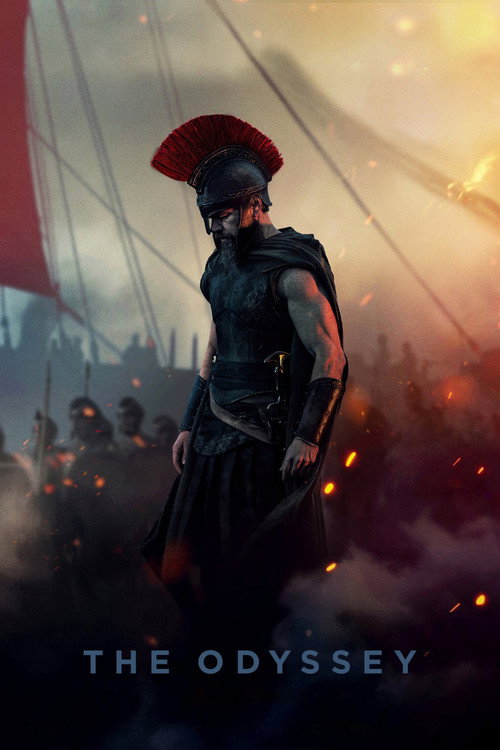
Nolan's Odyssey: An Autopsy
 One Another
and grade a few things to see how One Another’s taste matches yours.
A film made by those who don't particularly like the Odyssey, for those who have never read the Odyssey. And at that, it's still not even fun to hate, like so many other products of cinematic activism. No, with this film, there's simply very little sport. It's dreadful, it's boring; hardly more than a chore: The lights go down. And what do we see first? A popular but miscast rapper baring his veneers, pounding on the table, shouting various disjointed... things at the audience. Bold.
Say, now is probably a good time to mention that when large studios make films of this… well, of this 'scale' isn’t the right word. The scale of this film is completely myopic. But let’s keep the cart behind the horse for a moment. Budget, let’s say. When big studios invest this much money, the director is given a target number of social media followers that their main cast must cumulatively tally across all platforms. The more you know.
And here's what you get: Some rapper. Don't worry, Nolan is waiting in the wings to assuage your sense of being duped after the show by assuring you that rappers are analogous to Homer, so, it's actually a very intelligent play and not at all a cynical bid to broaden the film's audience beyond… shall we say, or rather, let's not. Instead let's say this: What a perfect way to draw back the curtain. It's foreshadowing, from the greatest director of our times! See: for the next three hours the film's score will thump our heads like the bard is whacking the table. All the while a disjointed array of anachronistic figures are paraded across the screen in Greek-ish costume, and occasionally blurt out modern academic terms like "Bronze Age," and "Sea Peoples,” that have no place in the period. Three ungodly hours of washed-out barren landscapes that are supposed to pass for the Aegean; of melodramatic dialogue that sounds as though it was written by undergraduates. Three hours, painfully unwoven from the tapestry of our meager lives spent watching Nolan systematically undermine every single character he didn't find reason to cut from the text.
What didn’t we like about the Odyssey in particular?
Well, in short, it wasn’t really an adaptation of the Odyssey at all. It was, at its most indulgent moments, a haphazardly orchestrated inversion of the Odyssey. And for all the bloated runtime in between those sparse moments, it was just more standard fare from Christopher Nolan. Bland, bleak, emotionless, wooden. And so on, and so forth. Certainly not Homer. You see, the issue isn't that Nolan saw fit to alter the text. Not at all. 2004's Troy made significant alterations to the Iliad. And yet, that was nevertheless a fine film. It preserved the spirit of the text. The same can be said of Jackson's take on Tolkien's trilogy. Changed? Oh yes. Quite a bit, actually. Sometimes even too much. On occasion, even arguably for the worse. But nevertheless the filmmakers in those instances had obvious respect for the source material, and the way they went about changing it was decidedly not to undermine and subvert it. Because of that, they are beloved and so far have stood the test of time. Nolan's Odyssey by contrast is a vanity project that will not age well. Once the studio's contracts expire with the influencers who are currently being paid handsomely to spam inauthentic short-form content all over social media, few people will ever have the stamina to sit through this distended mess a second, or god forbid a third time.
But instead of banging on finding new ways to describe how forgettable this flick was, perhaps it will serve better to examine a few of the most egregious cases of character assassination on-offer. Let's look:
For the ancients, the character Sinon is a deceiver. He lies to the Trojans, he speaks with a forked tongue. Dante places him with others of this sort, by name, in a deeper circle of the Inferno. But for Nolan, Sinon's deceit is perpetrated instead by Odysseus. Of course. Odysseus is the liar, and Sinon is only the poor sap whom Odysseus heartlessly betrayed. We should be careful to keep the story of Caesar's death out of Nolan's hands, lest he write Brutus to be someone other than a notorious traitor. Nolan's Brutus would probably have his hand in his pockets instead of gripping the first knife buried in Caesar’s back.
Take Circe, as well. For the ancients she is a beautiful enchantress with ‘hair like fiery rays’ living in a lavish palace on a wooded island, tempting and transforming transgressors into animals. Her perilous and decadent charms have enamored readers for two thousand years. But for Nolan, Circe is a squawking old hag squatting in a rotten hut. She smears her hands all over the faces of his men in a cheesy display of grotesque villainy. She lectures and wags her fingers at the soldiers who, so far as we are shown on screen, perpetrate no apparent transgressions. What dialogue she offers is corny, ham-fisted, and delivered with such insipidity it’s frankly hard to watch. Shrieking like a bad drama teacher, she threatens Odysseus with table cutlery. And after all this, Nolan contrives for Odysseus to apologize to her. For what, exactly? Who can say. His men were perfectly polite. She offered them food, they were hungry and grateful. She asked them to leave their weapons, they obliged. The pigs! Whoever this old woman is, she certainly bears no resemblance to Circe. If anything, again, she is her opposite.
Penelope suffers the same fate. Homer details her allure, her modesty, grace and eloquence—her cunning devices to evade the suitors, an even match with the cunning of Odysseus (fancy that)—yet all these traits are replaced, here, by petty bitterness and more self-aggrandizing lectures. She mocks and degrades her own son, she speaks to and of her husband as if he is an animal. She scowls and barks, and bares her teeth, she jabs her finger at herself and says "the throne is mine!" And yet, not twenty minutes earlier she begged Odysseus to abscond and abandon their kingdom, as if she had no sense of obligation whatsoever. “Escape these walls?” Are they not your walls? To call this character Penelope is bluntly strange. She seems, no matter how you hold the script up to the light, to be the opposite of Penelope.
Much the same can be made of Helen, who, for all Lupita Nyongo's bleating in the press about Homer's apparent misogyny—not enough "screen time" for "these women" in the text she alleges—it's our recollection that Homer's women commanded hundreds and hundreds of lines of his poetry. Helen, for the ancients was a beautiful, tragic, grief-stricken queen, who struggles with her own culpability in the unraveling of so many destinies. Kunopis, she calls herself. Shameful. The world's most beautiful woman shakes her head no, "I have the eyes of a dog." Yet for Nolan, she racks up barely three minutes of screen time from an excruciating total nearing two hundred. My, my. That's embarrassing for the actress, isn't it? Well, what does she do with that screen time? We see her awkwardly and self-righteously lecture Menelaus. An odd choice. Not Helen at all. Who is this person?
Nor is Calypso spared the sting of the modern pen. In Nolan’s treatment she isn’t imprisoning Odysseus against his will. No, no. That would make Odysseus far too sympathetic. Instead, Odysseus imprisons himself by enjoying the amnesiac-lotus so much, that Calypso couldn’t bring herself to put a stop to his gluttony. So you see, it’s Odysseus’s fault that he’s Calypso’s prisoner. “Willingly,” she says; directly the opposite of Odysseus in the text—who was her unwilling captive. Who wept on her shore, begging to be let home, for years. Alexander Rothaug's beautiful portrait of Ulysses despairing on the rock; Nolan is apparently unfamiliar. Even her name, kalipso, in the Ancient Greek identifies her as the force which hides Odysseus away from the world. But in Nolan’s hands Calypso becomes little more than a blameless therapist who medicates a weak husk of a man—patting him on the back until he is ‘ready’ to leave of his own accord. Why call this character Calypso? She's inarguably an invention of the writers. She is Calypso's opposite.
And what about Odysseus himself? Well. We’ve already gotten a taste of how gutted and hollowed-out Nolan's interpretation of him is by inspecting Calypso, so let’s look at the text for a moment. For the ancients Odysseus is cunning to the point of hubris. The poem’s opening lines can be rendered something like “Sing, muse, of a man turned this way and that.” But take care to scrutinize the Ancient Greek and you’ll have a brilliant decoction of Homer's hero: It is deliberately unclear if Odysseus is the one ‘turning,’ or if he is the one ‘being turned.’ Is Odysseus clever enough to ‘turn’ the will of the world to his advantage; to outsmart the gods, to contrive the devices with which to command his fate? He certainly tries. Or, is he being ‘turned,’ is Odysseus only transgressing the gods in the attempt; is his fate to be blown about forever on misfortune of his own making? Clever he is, yes, but never clever enough to know when enough is enough. Brash. Hubristic. That is Odysseus. Homer asks what-if-any control a man can exercise over his own destiny. Nolan asks… nothing of the sort. Nolan neither asks nor says much at all. This is likely due to the fact that Nolan made the clumsy choice to reference the contemporary translation by Emily Wilson (rather than a defensible translation like, say the Fagles). In Wilson's fumbling hands the text acquires ulterior motives. It is reduced in all sorts of controversial ways. Not the least of them being her treatment of those very same opening lines: she strips them of all power and purpose, rendering simply, “Sing, Muse, of a complicated man.”
Oh… oh dear.
So whatever we’re watching here isn’t the Odyssey. Alright, that’s out of the way. Let’s be amenable filmgoers then and adjust our expectations. Is it at least a decent film about Ancient Greece?
Well, no. No it isn’t. Probably enough words have been spared for the corny dialogue. If only that were the end of it. The costumes range from boring to baffling. Nowhere in sight is anything that could be considered remotely related to Bronze Age Grecian costume. Characters bumble around wearing chunky foam helmets like they've lost their way to the local strip mall's comic convention. The Trojans' costumes are frankly stupid-looking. Agamemnon has been widely and rightly mocked online for being presented like Batman or Darth Vader. It looks goofy to the point of being unintentionally funny. As far as the eye can see are gauche suits of unprecedented and uselessly designed armor, what appears to be velcro vests, arms covered in sleeves and legs covered in pants. Must we even say it? Perhaps the most hilarious instance of the costume department going off-reservation is the suitor who is noted (several times) for wearing loud, jangling spurs. It begins to feel less like an oversight, less like laziness, and eventually more like the filmmakers are pointing and laughing at anyone foolish enough to have paid for a ticket. Thankfully we had the foresight to sail the high seas like Odysseus of yore, our wallets concealed safely in the folds of our tunics.
The sets receive the same treatment as the costumes. Easily the worst offender is the temple of Athena in Troy. It isn’t really a temple or a fane in any sense of the word. Like the rest of this film, it isn’t particularly anything at all. Maybe if you stand back twenty feet from the screen and squint... and forget anything you may know about the work of Greek architects… well… ah but even then, no. It appears to be a porte cochere torn off the front of a Miami hotel. What were they thinking? Charles Moore did a better job building an Italian Piazza in New Orleans and his stated goal was to mock and subvert the very idea of such a thing. One begins to wonder where all the money went. It didn’t go to paying anyone to edit the script. It didn’t go to paying anyone to supply oversight for the costumes, it didn’t go to set design. Construction maybe, but design? Obviously not. Hmm. Where could it be?
Ah! It says here that Zendaya only had about five minutes of screen time—most of which was her staring blankly at Matt Damon—and she was apparently paid somewhere between five and eight million dollars for the trouble. Reports vary. Rumors swirl. So… in light of the fact that even the worst actors in the film are being paid more than a million dollars a minute, it's little wonder there was no provision in the budget for someone to say ‘What do we gain by having Bronze Age Greeks wear sneakers,' or 'perhaps we ought to reconsider exonerating one of history’s most notorious liars at the expense of one of history’s greatest heroes?’
Now. We are well aware that this review (much like Nolan’s Odyssey) probably ought be about half as long as it's ended up being. But in for a penny, as they say; why not tack on one final thought here before we say you’ve got your money’s worth. The collector's edition popcorn bucket was an outrageously priced $70.00 hunk of plastic, after all.
So as we sit here, equal parts exhausted and insulted—the awful pounding ‘soundtrack’ still, three hours later, on the verge of committing us both to the psych ward—finally Nolan permits us to see Odysseus and Penelope reunited. And how is it presented; one of the greatest scenes in the history of Western literature? Odysseus offers a melodramatic monologue about himself, in the third person, over footage of flashbacks that we’ve already seen more than once before. Bravo. Bravo! Reeling then, from the blow of that choice, Anne Hathaway delivers the kidney-shot; the worst line in the entire film: “You are,” she stammers, choking back tears, “the Sea People?” And Matt Damon nods.
Just a moment.
The Sea Peoples (which by-the-by is a term introduced by 19th century scholars to generalize Aegean raiders) were named historically. Tribe by tribe. The ancients named them, and located them. They evidently knew who these people were—they were neighbors. It’s only modern academics who have trouble piecing the picture together beyond the shadow of a doubt, for a whole host of complex reasons, and so the umbrella term “Sea Peoples” came into use relatively recently. Not only is it patently ridiculous that Odysseus would use this 1850’s term for tribes the names of which he well-knew, but beyond, the blame is again heaped on him personally. Much like Sinon’s lie became a placard around his neck, much like Calypso's activities were redressed to have been Odysseus's fault somehow, that wasn’t enough for these… people. Oh no, the blame for the collapse of the entire Bronze Age itself must also be disingenuously repackaged, dumbed down, rendered abjectly ahistorical, and then explicitly presented as Odysseus’s personal doing by his own wife. Who, for two thousand years has exemplified the union of love and loyalty perhaps moreso than any other character in the literary canon. Is Odysseus responsible for climate change as well? Given another half hour of runtime perhaps he might have been.
With a blank check for a budget, apparently no constraint on runtime, and a built-in rabid audience who will scrutinize the gum under Christopher Nolan’s shoes for evidence of deeper meaning—every single obstacle in the world removed that might stand between a filmmaker and a great adaptation of a classic like the Odyssey—one can be forgiven for having been optimistic. Alas that ship, it seems, has sailed.
But at least he used practical effects!
-
Yours, egotistically

Also reviewed by kenzoA, Adam MiltonA- and Electric SheepB+
Comments16
to leave a comment
I suppose I can understand your logic there, I don't think it would make me change my mind but I definitely get it. It's similar to another Nolan film that I actually think is overrated and my complaints are with the depiction, The Dark Knight. His interpretation of the character isn't my favorite by any means, which is why for me The Batman (2022) is my preferred Batman film. However; I think when I look at it from the perspective of a just movie on it's own and not tied to the comic character per say, I think its a great watch. I think it just depends on how much you want to put a movie under a microscope.
Agreed!
"the way they went about changing it was decidedly not to undermine and subvert it." hello based department
Hold please...
lmfao
The kids seem interested
I will say that for a story that is ostensibly carried by the actions and decisions of women, it is ironically funny that the guy adapting it has a long history of making movies where women mostly stand there and watch men do stuff. It's one of Nolan's most persistent criticisms. I was a bit annoyed that Athena basically got relegated to a spectator in the movie.
Funny, that. What's more, Athena was diminished to some sort of weird, Jungian projection of Odysseus's personal demons. And even still, couldn't even be permitted her own form. No, she was actually just a priestess the death of whom (surprise surprise) is again blamed on Odysseus. One of the most telling scenes in the film, I think, was Odysseus pissing in the face of Menelaus inside the belly of the horse. Nolan even positioned the camera low, so we-the-audience could experience being pissed on by Odysseus. Hmm. Maybe he is a genius after all...
What exactly about this adaption from the source material did you not like? I was also pretty worried about this going into the movie, as someone who has read the Odyssey, but I left pleasantly surprised. For sure its not a one to one copy of the poem, but I feel like the changes that were made were not egregious and some enhanced the movie. For instance when Odysseus travels to Hades, instead of speaking with Achilles, they have him encounter the solider he was supposed watch over. I actually liked this change, to me it gave more weight to his character. It's easy to see why Odysseus would defy the gods to try and bring all of his men home, but when you see his face as he looks back at the shore to the sea of men not coming home with him, you feel it. Changes like that I can appreciate, while others I may care for less like adapting the cannibal island. I think the modernization of the movie turned out for the better, its hard to make an epic when the main character is filled with infidelity and arrogance.
Hey thanks for your comment! It would probably be easier to list the things we did like, than the things we did not. Let's see. The actor who portrayed Argos did a fine job. Hmm. That's about it. Perhaps a long form autopsy of this disaster is in order... Criticism of this particular director always seems to strike quite a nerve.
Of course, thank you for the post. I actually am not a big fan of Nolan, I've only seen three of his films in total, so no nerve is struck. I was more so asking about your initial gripe with the film seeming to be a poor adaptation that viewers would like because they have not read the Odyssey. So I was curious what changes didn't sit right with you.
Updated the review to rival the runtime of the film!
I look forward to the comments