

Adventures in Ayn Rand Land
 Adam Milton
and grade a few things to see how Adam Milton’s taste matches yours.
Author's Note: This review was orginally written and posted January 16th, 2026. It was rewritten heavily on July 22nd, 2026 and posted again that same day.
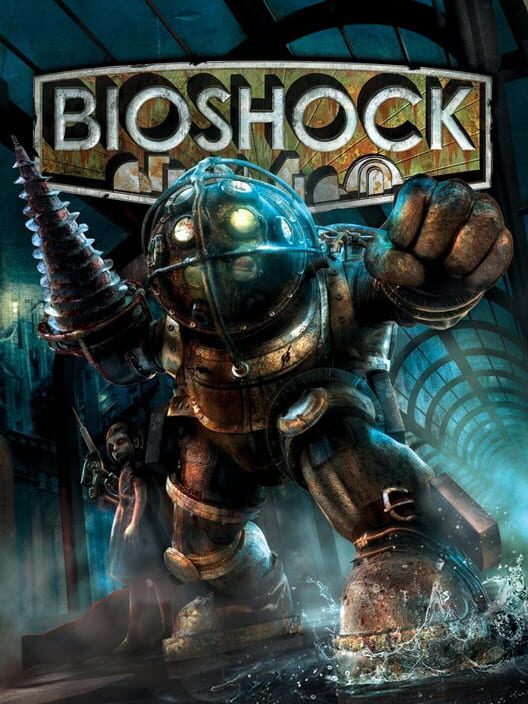
It was the cover story of a 2006 issue of Game Informer that first brought BioShock to my attention. The haunting image of a man in a massive steampunk diving suit holding a sickly little girl immediately captured my imagination. By that point in my life, online competitive gaming was beginning to lose its appeal, and an AAA, story-driven game was exactly what I was looking for. What I found was more than a great game—it was an experience I would revisit time and time again.
BioShock is roughly 75% first-person shooter, 12.5% RPG, and 12.5% immersive sim, set within a steampunk city, Rapture, beneath the sea. Rapture was built by Andrew Ryan, a man who exists philosophically and politically just to the right of Ayn Rand. You arrive at the city during the final days of a brutal civil war. On one side is Ryan, an objectivist visionary. On the other is Frank Fontaine, an opportunistic capitalist mobster. Both men have competing visions for what Rapture should become and who should control it.
The war is fought over a miraculous substance known as ADAM. Harvested from sea slugs, ADAM allows DNA to be rewritten, granting superhuman abilities known as Plasmids and passive enhancements called Gene Tonics. Unfortunately, ADAM also causes madness and addiction, transforming ordinary people into the Splicers: disfigured, unstable denizens of Rapture's failed dream. Ryan and Fontaine each recruit these desperate addicts to fight on their behalf.
Within the world of the game, ADAM is harvested from Little Sisters—young girls implanted with sea slugs in a grotesque surgical procedure. These children wander Rapture collecting ADAM from corpses while towering Big Daddies silently protect them. You'll watch a hollow-eyed little girl kneel beside a corpse, extracting ADAM with a syringe, while a massive armored guardian stands only feet away. It's one of gaming's most unforgettable images.
If you want stronger abilities, you need more ADAM. To get it, you must confront a Big Daddy, and they are absolute tanks. Fortunately, they are not naturally hostile. A Big Daddy attacks only when you threaten either him or his Little Sister, meaning you always dictate the terms of the encounter. You can prepare the battlefield, lay traps, gather ammunition, and plan escape routes before committing to the fight. Those preparations often determine whether you survive.
This leads to BioShock's most famous moral choice: save the Little Sisters or harvest them. Harvesting grants more ADAM immediately but leads to the game's darker ending. Saving them provides less ADAM upfront, but your compassion is rewarded later in the story. It's a simple decision mechanically, yet one that fits perfectly within the game's themes.
Splicers, however, are never optional. They'll attack the moment they see you. They come in several varieties: some wield pipes and pistols, others crawl across walls while hurling hooks, and some teleport to evade attacks altogether. Their combat variety remains entertaining for a while, but it's their dialogue that leaves the lasting impression. Their desperate ramblings about lost beauty, vanished loved ones, and shattered lives fill Rapture with a haunting sadness hidden beneath violent insanity.
The Big Daddies themselves come in two primary varieties. Bouncers rush their targets like freight trains, their enormous drills spinning as they charge. Rosies prefer to engage from a distance with powerful rivet guns, steadily wearing you down before you're close enough to fight back. Regardless of type, every encounter feels like a boss fight.
The story unfolds primarily through audio diaries and radio broadcasts. Nearly twenty years later, BioShock remains one of gaming's greatest examples of environmental storytelling. Every hallway, apartment, and flooded corridor tells another piece of Rapture's tragic history. Throughout your journey you'll communicate with a man named Atlas, who repeatedly asks, "Would you kindly..." help him rescue his wife and son. Equipped with period-inspired firearms, Plasmids, and Gene Tonics, you slowly fight your way through the city's remaining survivors.
The gameplay has undeniably aged, but it has aged in the same way The Wizard of Oz's special effects have aged. You notice their age, yet you also appreciate how groundbreaking they once were. Modernizing the combat by allowing players to dual-wield Plasmids and firearms would certainly make it smoother, but it would also make an already easy game even easier.
Veterans of Halo, GoldenEye, or Call of Duty will likely find the gunplay a bit too forgiving. Despite a respectable arsenal of upgradeable weapons, firearms often feel secondary to the Plasmids. You have electricity that lets you hurl lightning, fire that engulfs enemies in flames, telekinesis that lets you catch and return rockets, and ice that freezes enemies solid. The combat is at its best when you combine these abilities with the environment. A shallow puddle becomes an electric trap. A pool of leaking fuel becomes an inferno. Few games reward creative thinking as effectively.
Hacking also plays a surprisingly enjoyable role. Vending machines offer better prices, while hacked turrets, security drones, and healing stations become allies against the Splicers. Watching a wounded Splicer sprint toward a hacked healing station only to be electrocuted never gets old.
Despite the number of mechanics, BioShock does an excellent job teaching players how and when to use them. After introducing each system, it gives you the freedom to approach combat however you like. You can play it as a traditional shooter, invest heavily in Plasmids, or even march through Rapture with a swarm of hacked security drones at your side. Every playstyle feels viable.
When I first played BioShock, I was immediately captivated by its art direction. An Art Deco metropolis powered by impossible machinery, hidden beneath the Atlantic Ocean, remains one of the most memorable settings in gaming. Graphics inevitably age. Great art direction does not. Returning to Rapture in the remastered edition reminded me just how timeless the city's design truly is.
My biggest criticism of BioShock is the same one I had nearly twenty years ago: it's simply too easy. Resources are so abundant that most players can comfortably experiment with nearly every weapon and Plasmid during a single playthrough. Even the decision to save the Little Sisters comes with little long-term sacrifice because the game eventually rewards your kindness with bonus ADAM.
Death also lacks meaningful consequences. Instead of reloading a checkpoint, you're revived in a nearby Vita-Chamber while every enemy retains the damage you previously inflicted. It's a forgiving system that ensures almost anyone can finish the game, but it also removes much of the tension. Experienced FPS players are unlikely to find much challenge here.
The remastered edition itself is exactly what I wanted. It sharpens the visuals without fundamentally altering the experience and includes both sequels and their downloadable content, making it an easy recommendation for newcomers. (Reviews of the sequels will come in time.)
BioShock was an exceptional game in 2007, and time has only softened it into a merely excellent one. It can still stand toe-to-toe with modern first-person shooters because its greatest strengths were never its graphics or mechanics—they were its world, atmosphere, and storytelling. If the game falls short anywhere, it's because the developers chose accessibility over difficulty, wanting players to experience Rapture without becoming frustrated. That's a compromise I can understand, even if I wish the game had demanded more of me.
BioShock helped redefine what narrative-driven shooters could be. Its influence can still be felt today, and nearly twenty years later, it remains one of the easiest recommendations I can give. More importantly, it's still an incredible amount of fun.
Comments2
to leave a comment
"This is a hyper capitalist dystopia so everything is for sell" you probably mean "for sale" there? Game's still an absolute classic!
This is what I get for writing this review at 3 am. Thank you @guttergrudge