

Ground Breaking
 Adam Milton
and grade a few things to see how Adam Milton’s taste matches yours.
Oh boy. I have put this review off for months. I knew that once I started it, I would have to do them all, consider them all, and come up with a review that met my standards for clarity, fairness, and scope. I knew that if I started reviewing Star Wars movies, I would have to dive in headfirst and be ready to take on all comers.
So let me be clear about a few things. As with any review, I work hard to be clear about my points and to make sure you can follow my logic to my final assessment of the movie.
I also want to be fair. If I do not like a movie, that is fine, but if I see merit in part of it or know that it accomplished what it set out to do, I give credit where it is due. Not everything is for everybody, but that does not diminish the quality.
Lastly, I judge what is put on screen. Extended universes cannot be considered. However behind-the-scenes stories and apocryphal tales about production can influence my interest in a movie and may color my view I really work hard to put those notions into context. An actor being drunk on set won't effect my final analysis but an innovation in film or special effects can given that will directly result in what I see on screen. If they released the movie, I have to assume this is the product they wanted me to see. This is their best effort, closest to the goal they intended to achieve, and this is what I am here to judge.
With all of that said, here is my review of Star Wars: A New Hope.
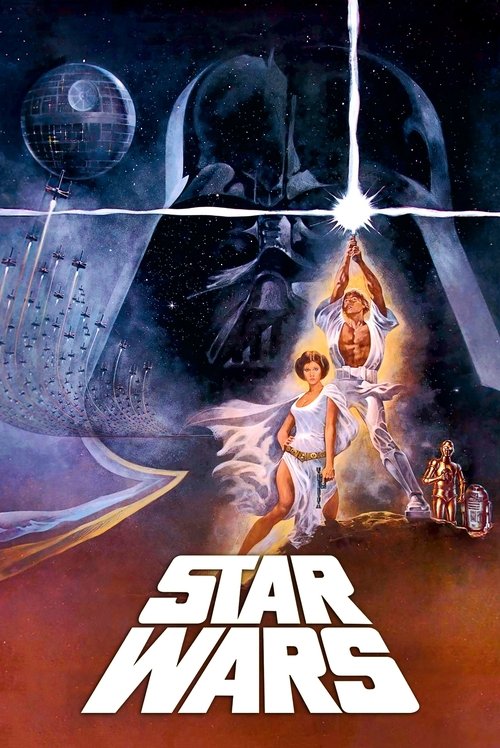
Star Wars was released on May 25, 1977. Directed by George Lucas, a young and talented filmmaker, ten years removed from USC and part of the “New Hollywood” movement, Star Wars is a classic science fiction story about rebels, evil empires, and destiny. Despite little faith from the studio system before release, Star Wars is the second punch in a one-two combination that is often credited with inventing the “blockbuster,” the first being 1975’s Jaws.
George is clearly a fan of old movie serials, as he starts his film in medias res after a title crawl. A movie serial is a form popular during the first half of the twentieth century, consisting of a series of short subjects shown in consecutive order at one theater. New episodes were shown weekly until the series was completed, and the openings often included a paragraph to catch viewers up if they had missed previous episodes. Genres often relegated to comics and pulp novels found a home in serials, including science fiction, westerns, spy stories, and espionage tales.
Set in a galaxy far, far away, Star Wars is about a galactic conflict between an evil empire and a rebellion. The Empire is a fascist-coded organization represented by a gaunt and cold man known as Grand Moff Tarkin. His right-hand man, and instantly iconic character, is Darth Vader. The Rebellion, or Rebel Alliance, is led by Princess Leia, supported by old allies and new friends. The color theory and cinematic storytelling in the narrative are deceptively simple. The viewer knows who is who from the music cues, framing, staging, and the colors surrounding the characters.
Alec Guinness and Peter Cushing are by far the most accomplished actors in the film. Both ground a science fiction story in real human emotion and drama. The rest of the cast punches above its weight and has excellent chemistry. Harrison Ford, playing a ne’er-do-well smuggler, oozes charisma and works well with everyone. Carrie Fisher, the daughter of golden-age Hollywood stars Debbie Reynolds and Eddie Fisher, plays Princess Leia. Fisher commands the screen whenever she speaks, despite everyone else towering over her. Mark Hamill plays Luke Skywalker. He throws himself into the role and never winks at the camera.
Some of the best characters in the film are not even human. Anthony Daniels plays a neurotic robot named C-3PO. He and his friend, another droid named R2-D2 played by Kenny Baker, work as a kind of Greek chorus by providing background details and reacting to the plot, almost guiding the audience as we enjoy the movie. Han Solo’s best friend is a seven-and-a-half-foot-tall creature named Chewbacca. Chewbacca is a Wookiee, half bear and half dog, and serves as Han’s copilot.
What John Williams is able to do for the movie with his orchestration and composition is nothing less than amazing. The score is iconic in many ways and helps to tell the story and set the stage.
Using models, forced perspective, matte paintings, and other special effects, Star Wars really stands out for its ability to bring an original and fun world to life. Lucas and Gilbert Taylor, the film’s cinematographer, do not get the credit they deserve for showcasing those effects. Often the difference between a good effect and one that is bad or ages poorly is how the production works together to hide the seams.
Star Wars, renamed Star Wars: A New Hope after its 1981 rerelease, shows what happens when everything just works and the entire creative team is in sync. Before this movie’s release, its closest references were in comic books, decades-old radio shows, and film serials. None of that made the kind of money that Star Wars would go on to make, let alone achieve its cultural impact. It is a testament to the skill of everyone involved, from top to bottom, that despite the doubt and the precedent that this film is as amazing as it is.
As a single movie, Star Wars is exceptional. Even now, it just works and it belongs on the short list of the most important films ever made.
Comments
to leave a comment
No comments yet